
Adjacent Work
Last updated August 2026. This page is live. It grows with the work, and it is corrected when I am wrong.

I have a degree in sociology and women’s studies. I read The Managed Heart in a seminar. I could have told you, with some confidence, what emotional labor was and who Arlie Hochschild is.
In 1997.
Twenty-nine years later I wrote a definition for a term I called Managed Composure and did not notice for a while that I had put her word in it.
That is one way this page came to exist.
The other was Loadbearing.
I had been using it for months, in essays, on this site, as the name of a book, before I learned that Will Larson had defined it in 2024 for something adjacent and not the same. I did not take it from him. I did not know about him. Both of those are true and neither is a defense.
Here is where I keep arriving.
I built this lexicon because the sector had no language for what it does to the women inside it. That claim is only worth something if I am honest about which language already existed. A body of work that implies first discovery where there was none cannot be trusted on anything else, and this one is asking readers to trust it on quite a lot.
So this page is the accounting.
It names the work that shares a term with mine and says what that work argues. It names the scholarship that got somewhere close under a different name, usually with evidence I do not have. And it states, as narrowly as I can, what I think is mine.
The terms here were developed in practice. Not adapted from books. That is a claim about where they came from. It is not a claim that nobody else has used the words, and for several of them somebody did.
If you are named on this page and I have described your work badly, tell me. I will correct it. If you know of work I have missed, the same.
A note on what a lexicon is
Terms are not property. A phrase cannot be owned, and I would not want to own one. What I have written are definitions, and what I have built is a structure that connects them. The copyright notice covers those. It does not, and should not, cover the words themselves.
The reason this page exists is not legal. It is that the alternative is a body of work nobody should believe.
I. Terms that share a name with existing work
These three matter most. A reader searching the term finds the other usage first.
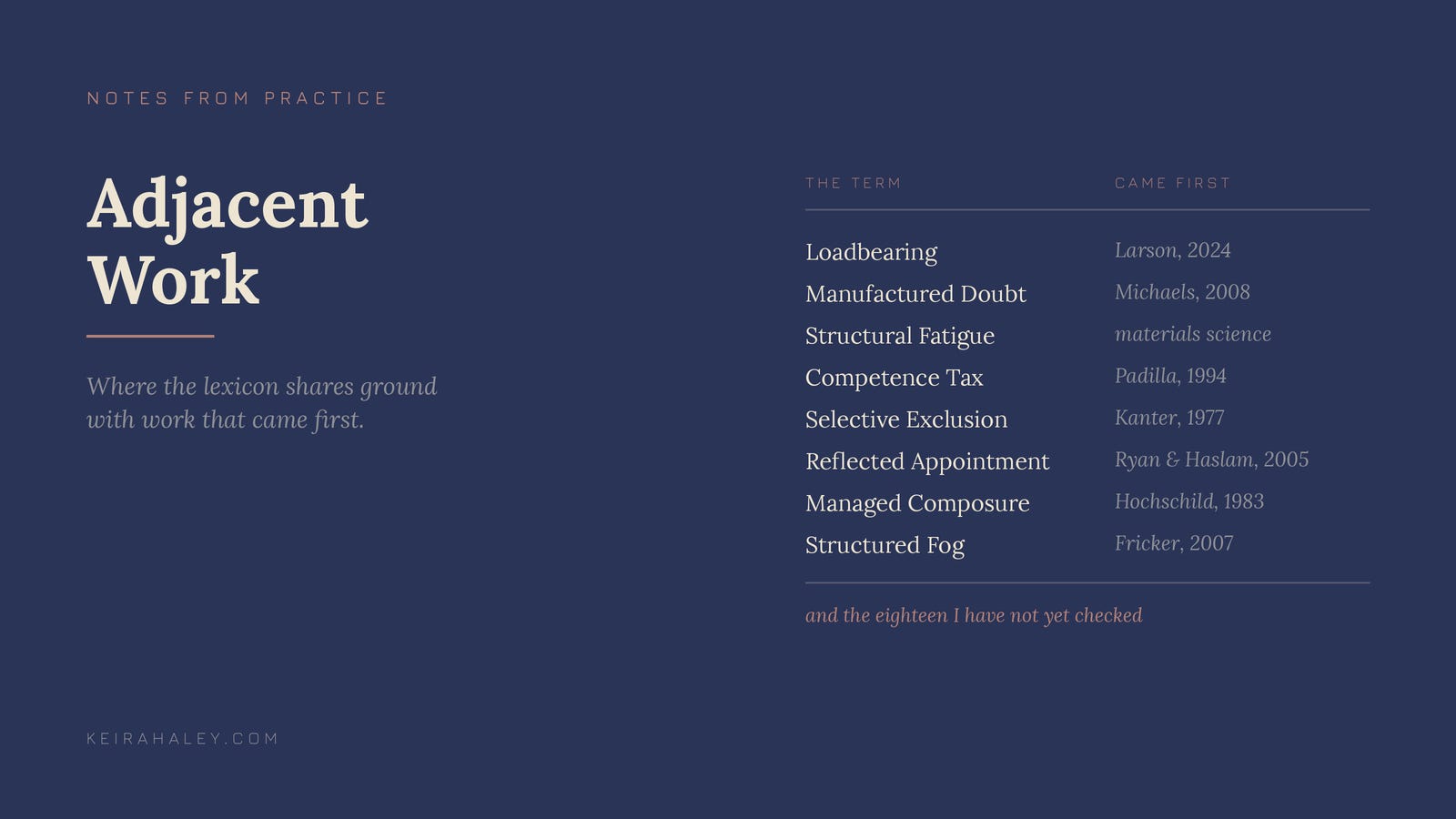
Loadbearing
Will Larson, “Load-bearing / Career-minded / Act Two rationales,” Irrational Exuberance, May 2024. Larson is an engineering leader and the author of An Elegant Puzzle, Staff Engineer, and The Engineering Executive’s Primer.
His definition: a person is load-bearing to the extent that there is no meaningful way to replace them. He treats it as a risk to the organization. He says it is normal for some people to be load-bearing at any given time. A healthy organization rotates it rather than reinforcing it.
Mine: a person, disproportionately a woman, designated to hold a dysfunctional structure together through individual effort, indefinitely and without institutional acknowledgment.
Larson is describing a succession problem. The organization is fragile because it depends on someone irreplaceable, and the fix is to spread the dependency. I am describing something the organization is not trying to fix. The institution is not fragile. It is working, and it needs the position to exist and stay unnamed. Rotation changes who is standing in it.
His frame contains its own remedy. Mine argues the remedy will not be applied, because the arrangement is load-bearing for the institution too.
I did not know his post existed. I am not claiming priority. I am claiming a different argument.
Manufactured Doubt
This is the larger collision.
Manufacturing doubt is the established name for a documented corporate strategy: producing scientific uncertainty to delay regulation. David Michaels, Doubt Is Their Product (Oxford University Press, 2008). Naomi Oreskes and Erik M. Conway, Merchants of Doubt (Bloomsbury, 2010). The phrase descends from a 1969 Brown and Williamson tobacco memo: doubt is our product.
That literature is tobacco, lead, asbestos, climate. Doubt manufactured outward, at a public, about an external fact, documented with internal industry records.
Mine: the systematic production of self-doubt in women by institutions that depend on it.
Theirs is an institution manufacturing doubt in others about the world. Mine is an institution manufacturing doubt in a person about herself, not to win a policy argument but to keep her.
Both are strategies. Theirs has archives. Mine does not, and I do not claim otherwise. Where they meet is the mechanism. Doubt is cheaper than concession.
If you know the Michaels and Oreskes work, read mine as their frame pointed inward.
Structural Fatigue
Structural fatigue and metal fatigue are established terms in materials science: the progressive, localized damage that occurs when a material is loaded repeatedly below its ultimate strength. Failure comes from accumulation, not from one overload.
Mine: the condition of a person, not a building, who has been asked to carry more than the structure was designed to hold, for longer than the structure was built to last, without acknowledgment, compensation or repair.
This is a transposition, not a coinage, and my own definition says so in its first four words. The logic is exact and the engineers had it first.
II. Terms with a different name in existing scholarship
Someone described something close to this, under a different name, usually with more evidence than I have.
Competence Tax → cultural taxation, identity taxation
Amado Padilla, “Ethnic Minority Scholars, Research, and Mentoring,” Educational Researcher, 1994, coined cultural taxation for the uncompensated labor expected of faculty of color: diversity service, mentoring, cultural interpretation, representation. Laura Hirshfield and Tiffany Joseph extended it to identity taxation. There is now a substantial literature, including a 2023 special issue of Ethnic and Racial Studies.
Mine: additional invisible labor assigned to you precisely because you can handle it, without acknowledgment, compensation or consent.
Theirs is assigned on identity. You are asked because of who you are taken to represent. Mine is assigned on capability. You are asked because you will do it well. The second is harder to refuse. It arrives as a compliment.
But the tax metaphor is theirs, the argument is theirs, and the scholarship is theirs. Read Padilla first.
Selective Exclusion → tokenism
Rosabeth Moss Kanter, Men and Women of the Corporation (Basic Books, 1977). Kanter’s tokens experience heightened visibility, performance pressure, and exclusion from informal networks and decisions, produced by proportional rarity rather than by anything about them.
Mine: the condition of holding a leadership title without leadership access. She holds the title. She is absent from the decisions. The institution needs both to be true at once. Her visibility as proof of inclusion. Her silence as proof of control.
Kanter’s mechanism is numerical. Mine describes an arrangement in a sector where women are the majority, which is the inverse of her condition. Tokenism in a female-dominated workforce cannot be a function of rarity.
Kanter is foundational here and I would not want the term used without her name attached to it.
Reflected Appointment → the glass cliff
Michelle Ryan and Alexander Haslam, “The Glass Cliff,” British Journal of Management, 2005. Women are disproportionately appointed to leadership during crisis, where failure is likeliest and will be attributed to them.
Mine: when the hire exists to confirm the judgment of the person who made it. The placement is not about the candidate. It is about the one who chose them.
The glass cliff is about when she is appointed. Mine is about why, and who the appointment is for. They are compatible. They often describe the same hire.
The opening of my essay “Powering the Sector Is Not the Same as Holding Power in It” is, in part, a glass cliff. Ryan and Haslam named that. I did not.
Managed Composure → emotional labor, surface acting
Arlie Russell Hochschild, The Managed Heart (University of California Press, 1983), introduced emotional labor and the distinction between surface acting and deep acting. Alicia Grandey built the regulation framework in organizational psychology from 2000.
Mine: when maintaining professionalism replaces necessary action, so the appropriate response becomes a way of not responding at all.
Hochschild describes a job requirement. The flight attendant is paid to produce a feeling in the customer. I describe composure as a substitute for action, where the performance is not the service but the alternative to providing one.
I will say plainly what I said at the top. My term shares a word with the title of her book. I have a degree that required me to read it. I did not notice at the time.
Hochschild is the ancestor of every term in this lexicon that concerns feeling.
Structured Fog → hermeneutical injustice
Miranda Fricker, Epistemic Injustice (Oxford University Press, 2007). Hermeneutical injustice occurs when a gap in collective interpretive resources leaves someone unable to make sense of a significant experience. Her central example is sexual harassment before the term existed.
Mine: the condition in which an institution’s dysfunction occupies the gap between experience and language, making harm visible enough to be felt and invisible enough to be denied.
Fricker’s gap is an absence. Nobody has the concept yet, and no one is at fault in the ordinary sense. Mine is a gap an institution has an interest in keeping. The fog is not weather. It is architecture.
This is the departure I am most confident in, and it is only possible because Fricker built the frame. She is named in my work and she has written back to me about it.
See also Kristie Dotson on testimonial smothering and contributory injustice, and Kate Abramson, “Turning Up the Lights: On Gaslighting,” Philosophical Perspectives, 2014, which treats gaslighting as an attempt to destroy someone’s standing as an independent deliberator.
Mission Shield, Institutional Narrative Replacement → institutional betrayal
Jennifer Freyd and colleagues have developed institutional betrayal since the mid-2000s, out of her earlier betrayal trauma theory (Betrayal Trauma, Harvard University Press, 1996). The work includes the Institutional Betrayal Questionnaire and DARVO: Deny, Attack, Reverse Victim and Offender.
Mine. Mission Shield: when the mission becomes the institution’s defense, redirecting harm back to the cause, so raising it feels like betrayal and silence feels like integrity. Institutional Narrative Replacement: the process by which lived experience is revised through institutional standards of legitimacy, risk and circulation until the revised version displaces the original account.
Freyd’s institutional betrayal is the harm an institution does by failing to protect. Mine is a specific instrument: the mission itself, turned so that naming harm reads as harming the cause. That instrument belongs to mission-driven organizations, which is a narrower claim than hers.
DARVO and Institutional Narrative Replacement overlap considerably. Where mine may add something is the displacement inside the record rather than the move in the room.
Freyd’s is a field with instruments and data. Mine is essays.
III. Two terms I am renaming
The Nonprofit Cycle becomes The Believer Cycle
Ann Goggins Gregory and Don Howard, “The Nonprofit Starvation Cycle,” Stanford Social Innovation Review, Fall 2009, named the loop in which funder expectations of low overhead lead nonprofits to underinvest and then misreport, reinforcing the expectation. It is one of the most cited phrases in nonprofit management writing.
Mine was something else: the pattern by which the sector attracts mission-driven women, extracts their labor, expertise and belief, pathologizes their exhaustion, and replaces them without examining the structure that produced the outcome. Theirs is financial. Mine is human.
But the names are close enough that this sector hears theirs first, and a term that has to be distinguished from a better-known term every time it appears is not doing its job.
The replacement is The Believer Cycle. It names what the pattern runs on, and it connects to the line the framework closes on: she leaves, and the language stays, then it recruits the next believer.
The old name is retired. Anywhere it still appears in published work, it means this.
Performative Philanthropy becomes Positional Giving
Nobody coined performative philanthropy. It came out of the performative activism and performative allyship vocabulary after 2020 and is now in general circulation. The National Committee for Responsive Philanthropy published “Performative philanthropy and the cost of silence” by Ray Holgado in November 2020. The phrase appears widely with no canonical source.
So there is nobody to collide with. There is a different problem.
Every other term in this lexicon hands a reader language they did not have. That one handed them my definition of a phrase they already had. It was the only entry doing that.
The replacement names what is actually exchanged.
Positional Giving: The practice by which institutional donors, boards and civic elites direct resources toward mission-driven organizations not primarily in service of the mission, but in exchange for proximity to power, social legibility and the cultural currency of generosity. What is purchased is position, and position only holds its value while others do not have it.
The word is borrowed. Fred Hirsch, Social Limits to Growth (Harvard University Press, 1976), named positional goods. Value that comes from standing rather than from the thing. It only works while it is scarce.
I considered and rejected Proximity Giving. In philanthropy, proximity already means something good, from Bryan Stevenson’s call to get proximate and the work on proximate leadership. A term for buying closeness to power would have read as praise for closeness to the community.
That is worse than a collision. It is an inversion.
IV. The wider lineage
I have not borrowed terms from these. The work would not exist without them.
On invisible and unrewarded labor. Tanya Reilly, “Being Glue” (2019), names the tasks. Linda Babcock, Maria Recalde, Lise Vesterlund and Laurie Weingart, “Gender Differences in Accepting and Receiving Requests for Tasks with Low Promotability,” American Economic Review 107(3), 2017: women volunteer more, are asked more, accept more, and advance more slowly. Their book The No Club (Simon & Schuster, 2022) is the closest comparable title to my own. Joan C. Williams on office housework and the promotion penalty.
On gendered organizations. Joan Acker, “Hierarchies, Jobs, Bodies,” Gender & Society, 1990. Christine Williams, “The Glass Escalator,” Social Problems, 1992.
On who ends up in care work. Amanda Diekman on goal congruity theory. Paula England on the devaluation of care work. Barbara Bergmann on occupational crowding. Erin Cech, The Trouble with Passion (2021). Miya Tokumitsu, Do What You Love (2015). Sarah Jaffe, Work Won’t Love You Back (2021), which argues the labor of love is the mechanism of exploitation. Jaffe and Cech arrive close to me from a different direction.
On burnout and its vocabulary. Herbert Freudenberger (1974). Christina Maslach. Charles Figley on compassion fatigue (1995). Jonathan Shay on moral injury. Anne Helen Petersen, Can’t Even (2020). Jonathan Malesic, The End of Burnout (2022), which also argues burnout is structural.
On credit. Madeline Heilman and Michelle Haynes, “No Credit Where Credit Is Due,” Journal of Applied Psychology 90(5), 2005.
And Charlotte Perkins Gilman, “The Yellow Wallpaper” (1892), whose name is on the framework because the pattern she described is the pattern.
V. What I think is mine
The definitions. Every definition in the lexicon was written by me, for this work. Where a term is shared, the definition is not.
The integration. The labor-invisibility half has been described by Reilly, Larson, Babcock and The No Club. The institutional-defense half by Freyd. The epistemic half by Fricker, Dotson and Abramson. I have not found a source that connects all three into one arc.
The reversal. That the crisis is not exhaustion but clarity. The burnout literature, including the structural burnout literature, treats depletion as the crisis. Depletion is survivable. Institutions handle it routinely. The rupture comes when she can describe the system accurately, because that is the thing an institution cannot absorb. I have not found that argument elsewhere. If it exists, I want to know.
The inheritance claim. That the naming does not change the institution, that it was never going to, and that what it changes is the attribution. From her failure to the structure’s design. And that the language outlives the person who made it.
Not that the observations are new. That this assembly of them is.
VI. What I have not checked
This page is incomplete and I would rather say so than let it look finished.
A proper terminology search is real research and I have not finished it. These have not been verified:
Constructed Compliance. Constructed Complicity. Embedded Judgment. Trust Inversion. Signal Return. Self-Assignment. Inherited Ambition. Mission Bind. Fluent Avoidance. Competence Inversion. Placement Immunity. Institutional Misattribution. Institutional Low Self-Esteem. Vision Without Sight. The Waiting Room. Argument Proliferation. To Sit With Cockroaches. Eggshell Culture. And both new names, The Believer Cycle and Positional Giving, searched but not cleared.
If any of those collides with your work, write to me and this page will say so.
I have been asked why I would publish this rather than quietly fix the footnotes.
Because the whole argument of this project is that institutions revise the record when the record becomes inconvenient, and that the revision is done quietly, and that the person who notices is treated as the problem.
I am not going to do that to my own work.
— Keira Haley
Trust the reader. Cut until it hurts. Earn the silence.