
Argument Proliferation
Argument Proliferation, Workplace Conflict Dynamics, and the Breakdown of Accountability in Organizations

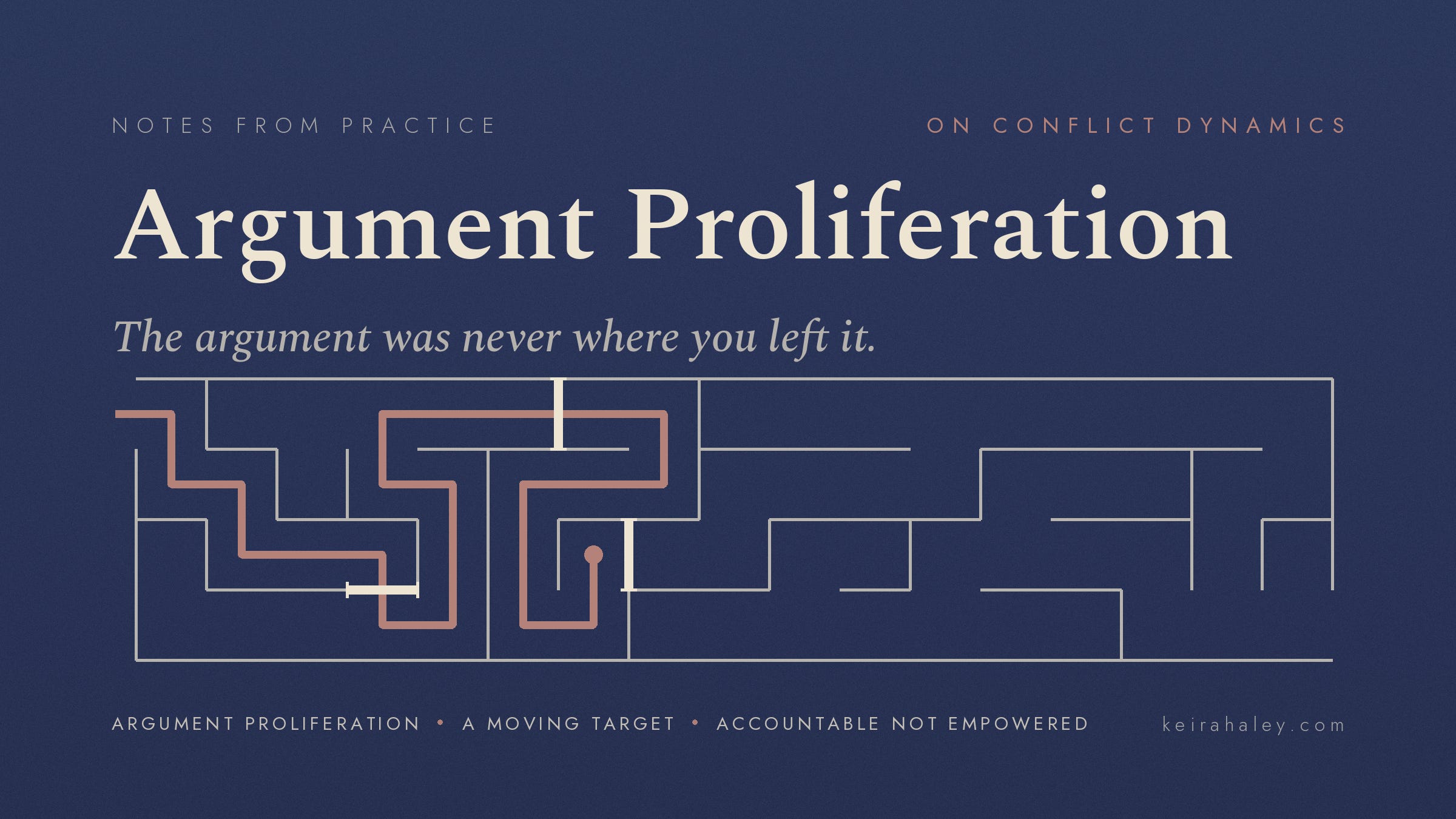
The argument was never where you left it.
We have all been there. Some of us more than once.
There are difficult management situations. Difficult behaviors. People who require careful calibration: every word measured, every conversation documented, every interaction logged somewhere you can find it later.
And then there are the ones who are off the charts.
The ones where no amount of KPIs, performance conversations, or structured attempts at resolution changes anything. Because you are not managing a performance problem. You are not managing a behavior.
You are managing a personality. And you cannot manage a personality with structure.
There was no single moment of knowing.
That is part of how it works.
It came in accumulation. One exchange at a time. The deliverable that was never quite right, not because the brief was unclear, but because clarity was never the point. Hours of re-editing that somehow became evidence that not enough time had been given. Access that existed until it didn’t. Plans that were requested, confirmed, and never delivered.
Each incident had an explanation. Each explanation was technically possible.
But the pattern underneath the incidents never changed.
The work was never right. The access was never there. The plan was never complete. And every conversation about it cost hours. Hours of careful language, of documented expectations, of requests for accountability that arrived the following week slightly reframed, slightly shifted, the original question still unanswered somewhere underneath.
This is Argument Proliferation.
Call it neither a lie nor gaslighting in the clinical sense. It's more specific than both.
Argument Proliferation is a conflict dynamic in which resolution becomes impossible because the subject of the argument does not remain stable. Each attempt to address a claim results in that claim being subtly altered, reframed, or replaced. The conversation progresses, but the core issue does not. Instead, it is displaced.
It is not defined by the volume or intensity of disagreement, but by the instability of the argument itself.
You resolve one question and another appears. You address that one and a third surfaces. You are always one exchange behind the original problem because the original problem is never where you left it.¹
You are not in a disagreement.
You are in a maze that keeps adding walls.
And the maze follows you everywhere.
You are in the meeting but you are not present. You are running the last exchange in the background, reconstructing the sequence, trying to identify which version of the argument you are currently supposed to be addressing. Your day is not your own. It is occupied by a moving target that requires constant tending. You find yourself working at 2am not because the work demands it but because the conflict does. Because somewhere in the day the actual work got displaced by the management of a dynamic that should have been resolved months ago and wasn’t.
This is the exhaustion that does not appear on any performance review.
The kind of tired that does not come from working too hard. The kind that comes from working on the wrong thing for too long.
You are tired not from doing your job.
You are tired from doing someone else’s.
There was no single moment of knowing because that is also part of how it works. The pattern reveals itself slowly enough that by the time you can name it you have already spent months inside it. You have already given hours you will not get back. You have already written the emails, held the conversations, documented the exchanges, and delivered the evidence to someone above you who has the authority to act.
And then you wait. Not because the answer is unclear. Because the answer is inconvenient.
The decision was not yours to make.
That is the other layer. The one that does not appear in management literature because management literature assumes you have the authority that matches your accountability. It rarely does. Not in this sector. Not for women in this sector.
You knew what needed to happen. You had known for months. The documentation existed. The pattern was clear. The cost to the team, to the work, to the hours spent managing what should not have needed managing, all of it was on record.
And none of it was enough to move the decision.
So you continue. You document. You manage up. You walk the evidence to someone above you who receives it carefully and finds it difficult. And you absorb that. You absorb the word difficult as though it is an answer. As though naming the difficulty is the same as addressing it.
You are accountable for the outcome. You are not empowered to produce it.
That is not a management problem. That is a structural one. And it has a specific cost that no one names. The cost of knowing exactly what needs to happen and being unable to make it happen. Of watching the cycle repeat not because you failed to document, failed to communicate, failed to manage. But because the decision lived above you and the person above you found it difficult.
You are not drowning in the work.
You are drowning in the gap between what you know and what you are allowed to do about it.
The cycle has one exit.
You cannot manage your way out of it. You cannot document your way out of it. You cannot restructure the reporting relationship or reframe the communication style or add another performance conversation to the record and expect a different result.
The only resolution is the decision that ends it.
¹ Argument Proliferation is the author’s own term. Related concepts include the Gish Gallop, overwhelming an opponent with volume, and DARVO (Deny, Attack, Reverse Victim and Offender). Neither captures the specific mechanism here: the instability of the claim itself, which shifts each time it is addressed, making resolution structurally unreachable.