
Fundable Harm
How Donor-Facing Language Transforms Student Lived Experience into Fundable Narrative

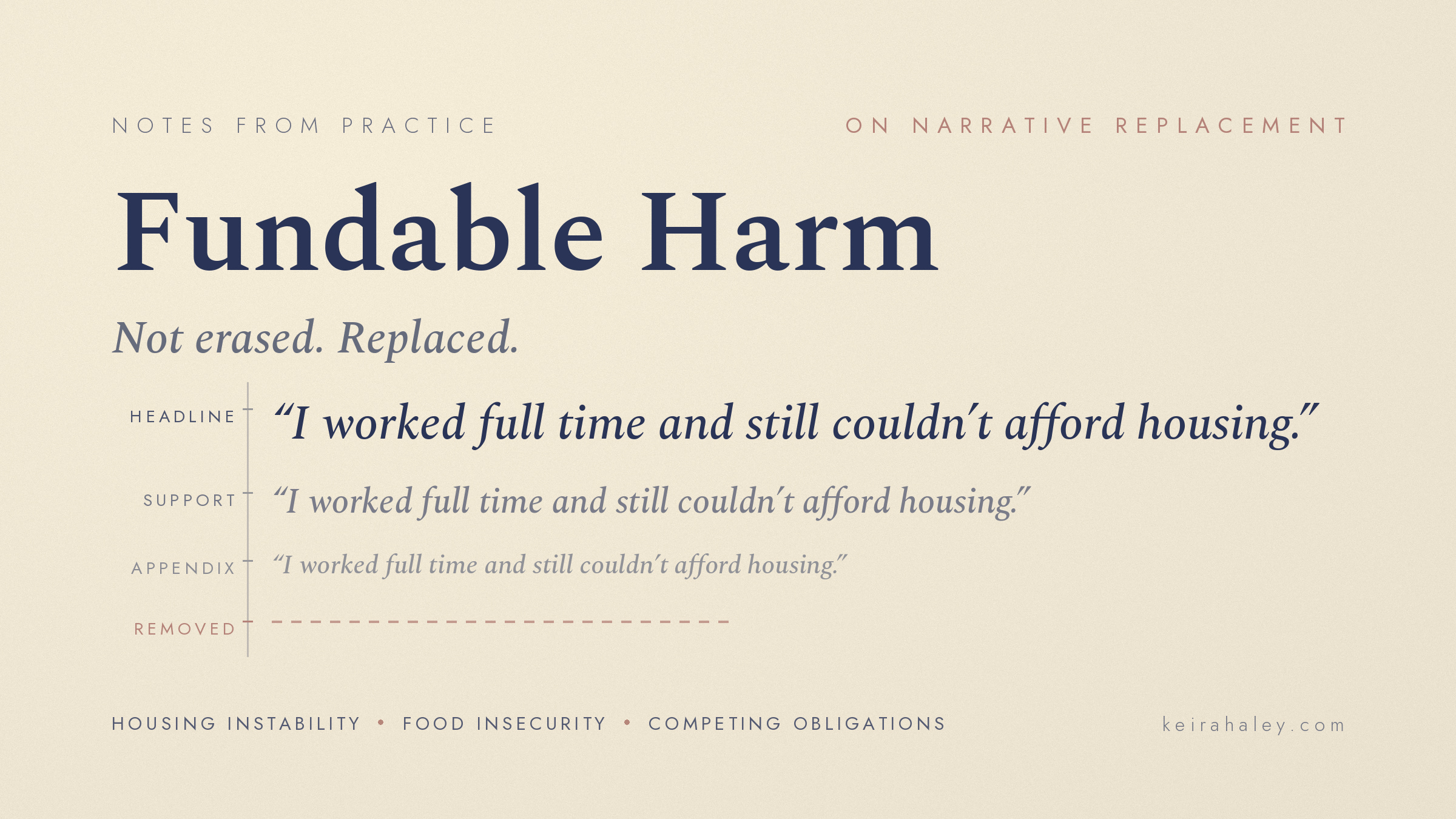
I am reviewing donor-facing copy for a scholarship campaign.
It contains student language pulled directly from lived experience.
A student working two jobs to stay enrolled. A student choosing between rent and textbooks. A student describing the moment they almost left the institution.
Someone writes in the margin: too specific for lead narrative.
No discussion follows it.
It is not framed as disagreement.
It is simply understood as part of how institutional narratives are built.
We revise it.
The language becomes:
“Students demonstrate persistence in the face of financial pressure.”
The sentence is now campaign-viable.
It no longer belongs to a single life.
It can circulate.
I start doing it before anyone asks.
When I began working in the nonprofit sector, I understood it.
Not the mechanics. The purpose. The reason you stayed late and answered emails on weekends and believed, without needing evidence, that the work was worth what it cost you.
I had always been able to make people feel understood. In eighth grade my phone rang constantly — friends, acquaintances, people I barely knew who somehow knew to call me. I don’t know exactly what I gave them. Only that when they think of me, they think of being accepted. Of feeling seen.
I thought understanding people was inherently protective. I did not yet understand that institutions could use the feeling of being understood without preserving what was said.
The sector found a use for that instinct.
Not through a single decision. Not through a moment I could point to later and say: there. That is where it changed.
Only gradually. As I learned what kinds of stories could survive institutional review and what kinds could not. As I became fluent in the weight a sentence needed to lose before it could move cleanly through fundraising language.
I did not lose my empathy.
I watched it become a production tool.
In early drafts, I remove details I already know will not survive review.
A missed rent payment becomes housing instability. A skipped meal becomes food insecurity. A night shift before class becomes competing obligations.
Nothing is corrected.
Only reshaped into language institutions know how to carry.
I can feel the moment a sentence becomes safe enough to circulate.
There is a donor briefing deck.
A slide includes a student quote:
“I worked full time and still couldn’t afford housing some months.”
A pause.
Someone says: “We should contextualize this rather than foreground it.”
No one asks what contextualize removes.
Because inside fundraising culture, that question is already resolved.
The quote moves.
From headline to support. From support to appendix. Then it is removed from the final narrative.
Nothing breaks.
The specificity simply stops circulating.
A development meeting.
A campaign narrative is open on screen.
A student describes missing classes while working overnight shifts.
It becomes:
“Students balancing employment and academic commitments may experience fluctuations in engagement.”
No reaction follows the change.
That absence signals alignment.
The pattern becomes visible in repetition.
A student describes nearly withdrawing due to housing loss. Becomes: housing insecurity affecting retention.
A student describes skipping meals. Becomes: food insecurity impacting persistence.
A student describes sleeping in a car between shifts and class. Becomes: unstable living conditions during enrollment.
Each revision removes the detail least compatible with institutional language.
Each revision increases narrative usability.
I leave a line unchanged in a grant narrative:
“Jake cannot afford to be here, but he shows up everyday.”
My cursor stays at the end longer than necessary.
I do not revise it.
Not because it feels complete.
But because I already know what institutional review would produce in its place.
Something smoother.
Something more general.
Something easier to move through donor-facing systems.
There is a donor meeting where a quote is flagged.
“It’s powerful,” someone says. “But it’s anecdotal.”
Anecdotal is not a judgment of truth.
It is a judgment about what can function as evidence inside fundraising language.
The quote is moved into “student voice.”
It no longer functions as evidence.
Only supporting material.
I begin to recognize the standard more clearly.
What survives is not what is most true.
It is what can move through institutional systems without disrupting the narrative flow.
That is the filter everything passes through.
Even when it is never named.
I used to think the problem was visibility.
Now I think it is what institutions require before experience becomes fundable.
What must be removed from a life before it can circulate cleanly through donor-facing language.
Because what moves through these systems is not what happened.
It is what survives institutional review.
And institutional review is never neutral.
It determines what kinds of lives can be spoken in ways that remain legible to funding structures.
I didn’t have language for this while I was inside it.
Only repetition.
Redlines that moved in predictable directions. Reframes that consistently reduced specificity. Drafts that became easier to circulate the more friction they lost.
Later, I found language for it outside those rooms.
Not as explanation.
As recognition.
What cannot circulate does not remain.
Not erased.
Replaced.
By language the institution can safely carry.
It cost me my relationship with myself.
My trust in myself.
My certainty about my own ethics.
Institutional Narrative Replacement: The process by which lived experience is revised through institutional standards of legitimacy, risk, and circulation until the revised version displaces the original account as the institutionally usable form of knowledge.
Trust the reader. Cut until it hurts. Earn the silence.