
Powering the Sector Is Not the Same as Holding Power in It
That sentence is the entire problem.

A woman steps into a leadership gap. The institution is at a crisis moment: relationships frayed, board disengaged, a strategy that isn’t working. She diagnoses it. She does the work. She rebuilds what was broken and demonstrates what leadership had decided wasn’t possible.
Then she is replaced. A man is brought in, often someone leadership knew before, someone who didn’t build what he inherited. The woman’s record gets rewritten. Her contributions become invisible or, worse, become evidence of problems she supposedly created. The institution says nothing. The board says nothing. The search committee moves on.
This is not one story. This is the architecture.
I have seen it. Same story, different institutions, same ending. The work disappears. The record gets revised. The gender is always the same.
—
Nothing counts this.
There is no dataset of women replaced by men who inherited what they built. Nobody tracks whose diagnosis it was. Whose relationships those were. Who wrote the strategy the next person presented.
The work was never named. So it was never counted.
Here is what does get counted.
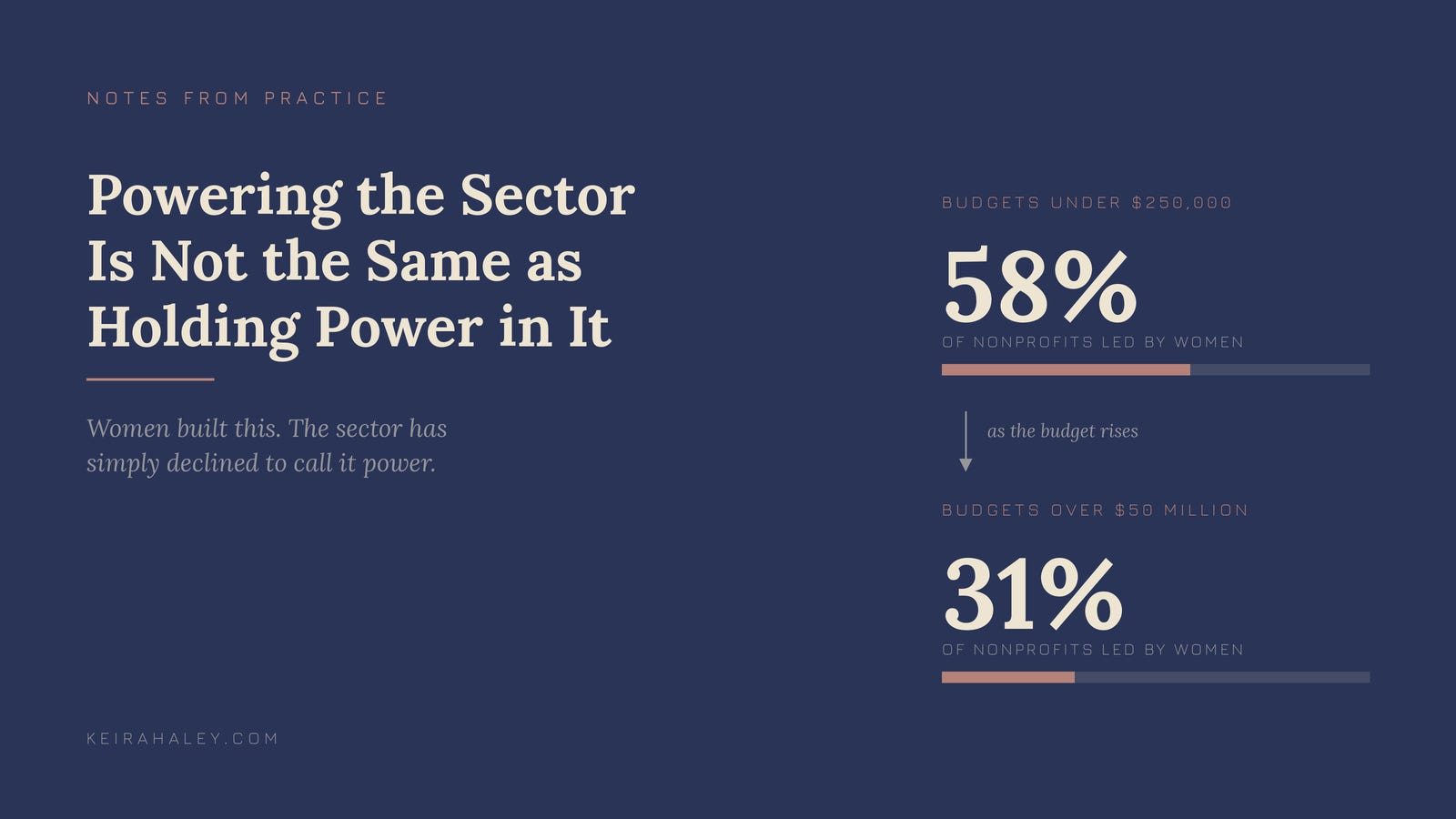
Women make up two-thirds of the nonprofit workforce. We hold 58 percent of leadership roles at organizations with budgets under $250,000. At organizations with budgets over $50 million, the ones that decide what gets funded, what gets ignored, what this sector is actually for, that number drops to 31 percent. The majority of large nonprofits are led by men.
Female CEOs at those organizations earn 75 cents for every dollar their male counterparts earn. It used to be 82 cents.
Sector-wide, the gap is closing. At the top, it is opening.
This is not the story. This is the shape the story leaves.
—
Sociologists call it the glass escalator. The way men in female-dominated fields move faster and further than their peers. Candid’s own research lead has documented it here, in this sector, alongside nurses and social workers and librarians and elementary school teachers.
Men are brought in, positioned, and handed narratives that women built. The infrastructure stays. The credit moves.
There is research on this specifically. Three experiments at NYU found that when a man and a woman succeed together and it is unclear who did what, she is rated less competent, less influential, and less likely to have led the work. The effect held unless the ambiguity was removed. Tell people exactly who did which part and it disappeared.
That is the whole finding. Where the record is unclear, it resolves against her. Where the record is explicit, it does not.
And now the sector is under additional pressure. The fields with the highest proportion of women leaders, environment and health and education and human services, are the same fields most affected by federal funding cuts.
Federal cuts are already driving the biggest wave of nonprofit mergers since the Great Recession. In a merger, the larger organization absorbs the smaller one’s programs.
The larger organization. The one least likely to have a woman at the helm.
Or the work stops.
Women built this. The sector has simply declined to call it power.
—
A sector built to fix what other systems break has decided this particular break does not need fixing.
—
Power in this sector is not complicated to describe. It is who controls the money. Who sets the agenda. Who can say no and have it mean something. Who tells the story afterward and has it believed.
The sector speaks fluent avoidance. We write about pipelines. We celebrate that women “power” the sector. We do not say: the sector has arranged things so that women do the work and men inherit the credit, and every time someone with authority chooses not to push back, they are making a choice. A different choice is available.
Powering the sector is not the same as holding power in it.
Trust the reader. Cut until it hurts. Earn the silence.
Thank you, Ryan!