
Strike and Return
How learning sentence diagramming shaped memory, language, and the way I understand structure, meaning, and emotional inheritance

My mother taught me to diagram sentences at our kitchen table. The table was round. The house was small. She was studying to be a teacher then, and in the evenings the house filled with the sound of her typewriter.
Strike and return, strike and return.
If you know the sound, you know it. Structure, made audible.
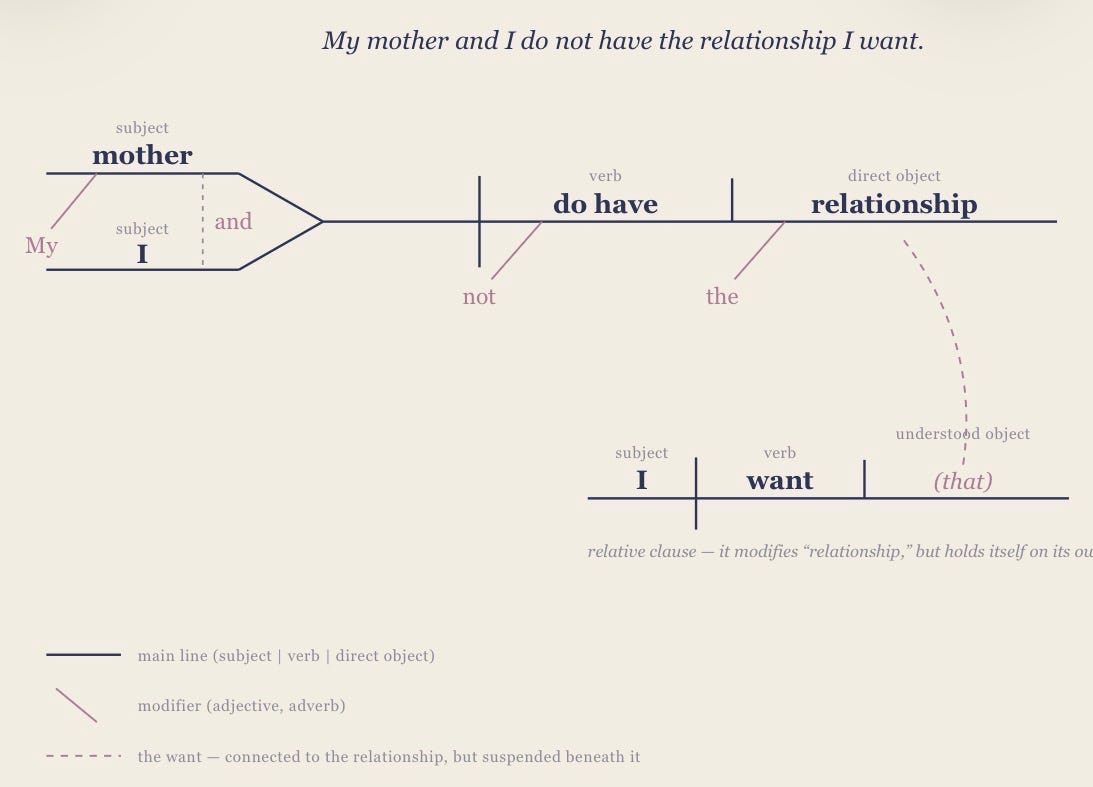
She would draw a horizontal line for what holds. A vertical line where the subject ends and the verb begins. Modifiers hung below on slanted strokes, like things that depend.
I didn’t want to learn where it was hard. I wanted to learn where it clicked. And this clicked. Here was structure in the midst of all that fluidity, a skeleton under the sentence, and it made complete sense to me. It still does.
They don’t teach diagramming anymore. Removed from the curriculum years ago — too mechanical, too rigid for how children actually learn. Maybe. But what my mother gave me at that round table wasn’t grammar. It was a premise I have spent my whole life testing: that under any sentence, under any structure that claims to be too complicated to explain, there is an architecture, and the architecture can be drawn.
She did become a teacher. The typing was her coursework; she was earning the thing she was already giving me. I fell asleep in our tiny Cape to the sound of it.
Strike and return, strike and return. Structure as lullaby.
My mother and I do not have the relationship I want. I can diagram that sentence too: subject, verb, object, and want hanging underneath on its own line, a modifier carrying more weight than the architecture suggests it should.
But when I recall the round table; the early evenings, the two of us bent over lines, I can see where we overlap. She handed me a way of knowing before either of us knew what I would build with it, and that horizontal line, the one that holds, runs from her kitchen to every page I have written since.
Strike and return, strike and return.
Trust the reader. Cut until it hurts. Earn the silence.