
Structural Fatigue
The Nonprofit Industry Calls It Burnout. It’s Actually Structural Fatigue.

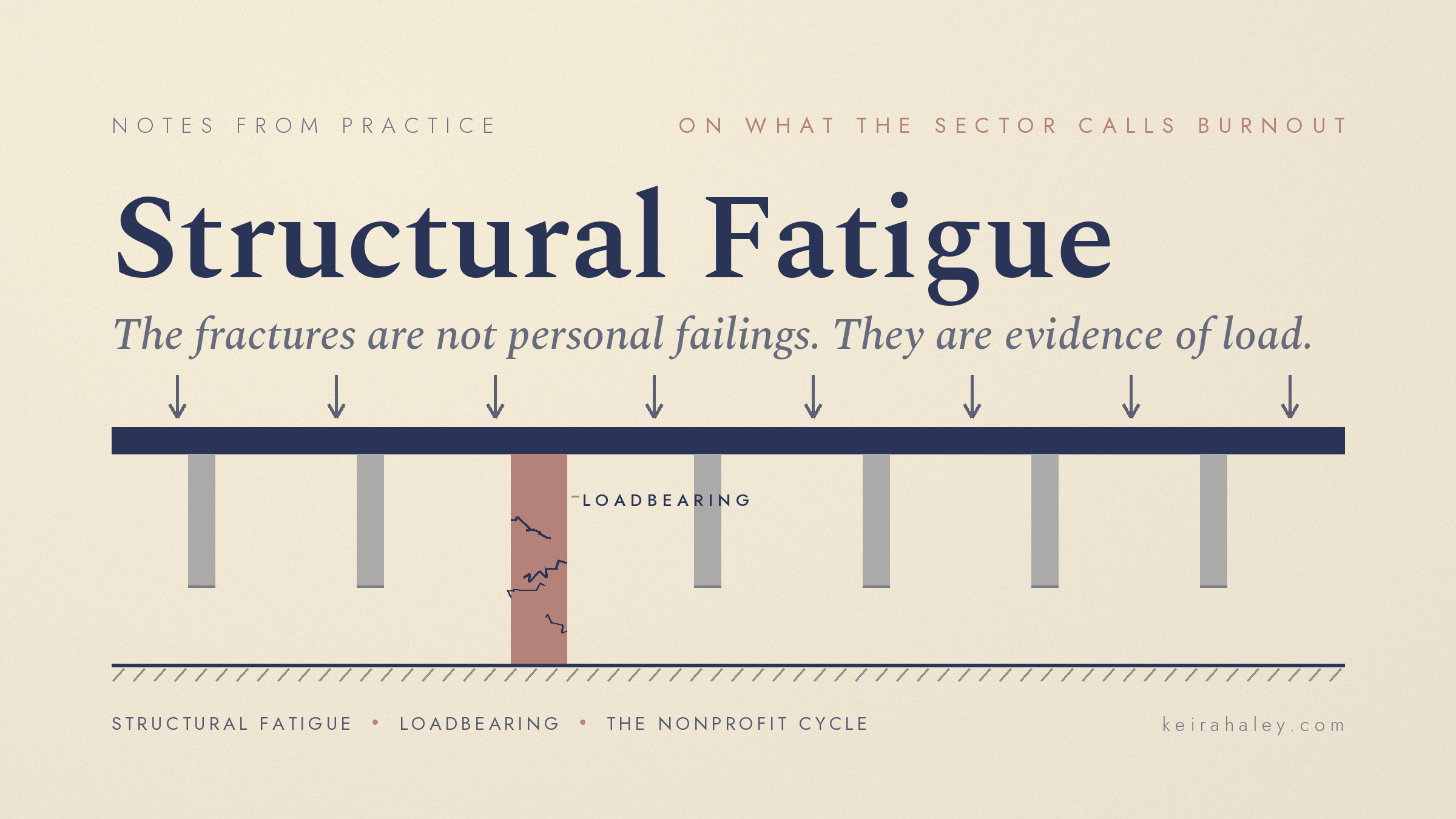
You didn’t burn out. You didn’t run out of compassion. You are carrying the weight of a structure that was never built to hold itself up without you.
That is not a personal failing. That is structural fatigue.
The sector gave you words for it.
Burnout was coined in 1974 by a psychologist named Herbert Freudenberger. He was describing the volunteer staff at a free clinic in New York City: mission-driven, underpaid, giving everything to work the institution was never built to sustain. That word traveled. It landed in nonprofit culture and never left.
Compassion fatigue followed in 1992, the emotional cost of caring too much, too long, for too many. Then moral injury, in 1994. It at least implied an agent, something done, a wound with a source, a violation that did not originate inside her but was handed to her by a structure that asked her to act against what she believed, or stood by while the mission she gave everything to failed the people it promised to serve. But even moral injury ended with her. Her wound. Her damaged conscience. Her loss of faith. The institution remained unnamed, unindicted, free to do it again. Then vicarious trauma, absorbing the pain of the people you serve until it lives inside you, until their story becomes part of yours without your permission. Then empathy fatigue, the slow depletion of the capacity to feel at all. The morning you wake up and realize you are going through the motions of caring without the feeling behind it. The quiet terror of that.
All of these words. All of these frameworks. Every single one of them pointed at her. Not one of them pointed at the structure.
Because the nonprofit sector has rarely developed a language for its own institutional failure. It has only ever developed a language for hers.
Burnout. Compassion fatigue. Moral injury. Vicarious trauma. Empathy fatigue. Each one a diagnosis handed to the individual, each one a way of naming what happened to her body, her psyche, her capacity to feel, without ever asking what the institution did to put her there.
The sector built the condition. Named it her fault. And when she left, it reached for the language of loss to avoid the language of accountability.
This is not a new pattern.
She walks in. She describes what she feels. The institution hears her and reaches for a label.
She describes chest pain and leaves with an anxiety diagnosis. She describes a decade of debilitating pain and waits nine years for someone to name it endometriosis. She is told her symptoms are stress, her hormones, her imagination. In 2024, a study of over 21,000 emergency room visits found that women still wait longer, receive less pain medication, and are more likely to have their symptoms attributed to anxiety than to the condition that is actually harming them. Medicine has been doing this for centuries. They called it hysteria, from the Greek word for uterus, a diagnosis that protected the institution by pathologizing the patient.
She describes what she experiences in the workplace. She is told she is not a team player, not leaning in, too emotional, too sensitive, too much, not enough. She describes the weight she is carrying and the sector hands her a pamphlet about resilience and a webinar on self-care.
And then there is the oldest version of this, the one nobody wants to put next to a conversation about workplace burnout because it feels too large, too serious, too far from a LinkedIn post about self-care.
She describes what happened to her. The institution, legal, medical, cultural, has no framework that holds him accountable. So it turns to her. Her skirt. Her drink. Her history. What she did or didn’t do. What she should have known. The institution was never built to hold him responsible. So it built the case around her instead.
These are not morally equivalent situations. The suffering is not the same. The stakes are not the same. The harms are not the same. The pattern is. Protect the institution. Name the woman. Move on.
Different institutions. Different centuries. Same design.
You cannot unsee it in the emergency room that sent her home with an anxiety diagnosis. You cannot unsee it in the sector that handed her burnout and called it care. You cannot unsee it in the institution that made her loadbearing and called it devotion.
She describes her experience. The institution has no framework. So it names her. And she, because she has been trained since birth to trust the institution over herself, accepts the diagnosis. Adjusts her behavior. Tries harder. Stays longer. Gives more.
Until she can’t.
And even then, even at the very end, the institution writes her departure as its loss. Not its failure.
The nonprofit sector attracts a particular kind of person, someone who learned early that her value comes from service, who will override her own needs because the work matters, who stays long past the moment she should have asked a harder question. The sector calls this passion. What it is, is a blind spot.
Arlie Hochschild called it emotional labor. Joan Acker named it the inequality regime. What neither framework fully captured is what happens when the institution weaponizes devotion. When belief itself becomes the extraction mechanism. When the mission makes self-sacrifice not just acceptable but virtuous. When martyrdom becomes the culture and leaving becomes betrayal.
The institution did not create her devotion. But it knew what to do with it. It made her essential. It made her invisible. It handed her the mission and called the weight of carrying it alone her personal strength. And when she finally collapsed under it, or left, or got quiet, or stopped being able to see the vision she came in with, the sector handed her a diagnosis. Words that protected the institution by naming only her.
I documented everything. I brought it with me. I believed the institution wanted to know.
The institution looked at my documentation and saw a problem. Me. The instinct, even then, was to wonder what I had done wrong. That is how complete the training is. That is how well it works.
Choosing me would have required it to see itself clearly, to hold what it claimed to believe up against what it had actually built and find the distance between them.
It chose itself. The way it has for centuries.
The institution was not always built by men. Women were the driving force behind much of the reform. Excluded from influential roles in government, they created their own voluntary associations, the settlement houses, the reform movements, the organizations designed to change the very conditions they were operating within. They built the sector. And then the sector absorbed the rules of the world it was supposed to disrupt, the hierarchy, the silence, the protection of the powerful, the displacement of accountability onto the least powerful. It did not matter who was sitting at the head of the table. The table itself was the problem. The women who built these institutions built them on the only ground available. Because there was no other ground to build on.
The research is consistent. Women make up 75 percent of the nonprofit workforce. Ninety-five percent of nonprofit leaders report burnout as a major concern. The literature responds with morning routines, boundaries, self-care, sabbaticals. Nobody asks what the structure did. Nobody names the institution as the one that extracted her devotion, made her loadbearing, and handed her the bill when the weight became too much.
This was built on the backs of women. That is not an accident of history. That is the design. And the cruelest part, the part that keeps it intact, the part that makes it almost impossible to dismantle, is that we are the ones holding it up. We accepted the diagnosis. We internalized the framework before the institution had to offer it. We defended the structure that was consuming us, advocated for the mission that was burying us, and trained the next woman to do the same thing. We did not just survive this system. We reproduced it. We mentored people into it. We told them it was worth it. We told ourselves it was worth it. And the sector never had to say a word, because we were already saying it for them.
The sector’s answer is a wellness industry. Boundaries. Self-care. Resilience training. Webinars on avoiding burnout delivered by the same institutions producing it. The content is confident and the confidence is the problem. It locates the solution inside her. It always has.
I have been inside this long enough to see the whole structure. I can see what the organization could become. I can also feel exactly what it is costing. That is not burnout. That is flying in a weighted vest.
The first step is not removing it. The first step is recognizing it was never yours to carry.
Structural Fatigue: The condition of a person (not a building) who has been asked to carry more than the structure was designed to hold, for longer than the structure was built to last, without acknowledgment, compensation, or repair. The fractures are not personal failings. They are evidence of load.
Loadbearing: The condition of being structurally essential but institutionally invisible. When she leaves, the structure does not reorganize. It collapses. That is not a metaphor. That is a job description.
The Nonprofit Cycle: The recurring pattern by which the sector attracts mission-driven women, extracts their labor, expertise, and belief, pathologizes their exhaustion, and then replaces them, without ever examining the structure that produced the outcome. The cycle does not require malice. It requires inattention sustained long enough to become institutional habit.
These terms are part of the working lexicon. Read the full framework in Call It What It Is or at keirahaley.com/lexicon
Sources
Freudenberger, H. J. (1974). Staff burn-out. Journal of Social Issues, 30(1), 159–165.
World Health Organization. (2019). Burn-out an “occupational phenomenon”: International Classification of Diseases. https://www.who.int/news/item/28-05-2019-burn-out-an-occupational-phenomenon-international-classification-of-diseases
Maslach, C., Schaufeli, W. B., & Leiter, M. P. (2001). Job burnout. Annual Review of Psychology, 52, 397–422.
Hochschild, A. R. (1983). The managed heart: Commercialization of human feeling. University of California Press.
Acker, J. (1990). Hierarchies, jobs, bodies: A theory of gendered organizations. Gender and Society, 4(2), 139–158.
Acker, J. (2006). Inequality regimes: Gender, class, and race in organizations. Gender & Society, 20(4), 441–464.
American Association of University Women. (2018). Broken ladders: Barriers to women’s representation in nonprofit leadership. https://www.aauw.org/resources/research/broken-ladders/
Center for Effective Philanthropy. (2024). State of nonprofits 2024: What funders need to know.
https://cep.org
Mind Share Partners & Qualtrics. (2025). Mental health at work report. https://www.mindsharepartners.org/2025-mental-health-at-work-report
Mission Edge. (2025). Talent, burnout, and retention: The defining challenge of the nonprofit workforce.
https://www.missionedge.org
Meints, S. M., et al. (2024). Sex differences in pain treatment in emergency departments. Proceedings of the National Academy of Sciences, 121(33).
Harvard Health Publishing. (2025). The dangerous dismissal of women’s pain. https://www.health.harvard.edu/pain/the-dangerous-dismissal-of-womens-pain
eClinicalMedicine / The Lancet. (2024). Gendered pain: A call for recognition and health equity. https://www.thelancet.com/journals/eclinm/article/PIIS2589-5370(24)00137-8/fulltext
The Lancet Obstetrics, Gynaecology & Women’s Health. (2025). Misdiagnosed, dismissed, ignored: The women’s health crisis. https://www.thelancet.com/journals/lanogw/article/PIIS3050-5038(25)00115-3/abstract
Social Welfare History Project. Women, settlements and poverty. Virginia Commonwealth University Libraries. https://socialwelfare.library.vcu.edu/settlement-houses/women-settlements-and-poverty
Knoop, C. I. (2025). Caring for those who care for others: Mental health in the nonprofit workplace and the paradox of pressure. Medium.
https://carinisabelknoop.medium.com
Judd, J. (2025). Blinded by cause. Stanford Social Innovation Review. https://ssir.org/articles/entry/nonprofits-blinded-by-cause
Trust the reader. Cut until it hurts. Earn the silence.