
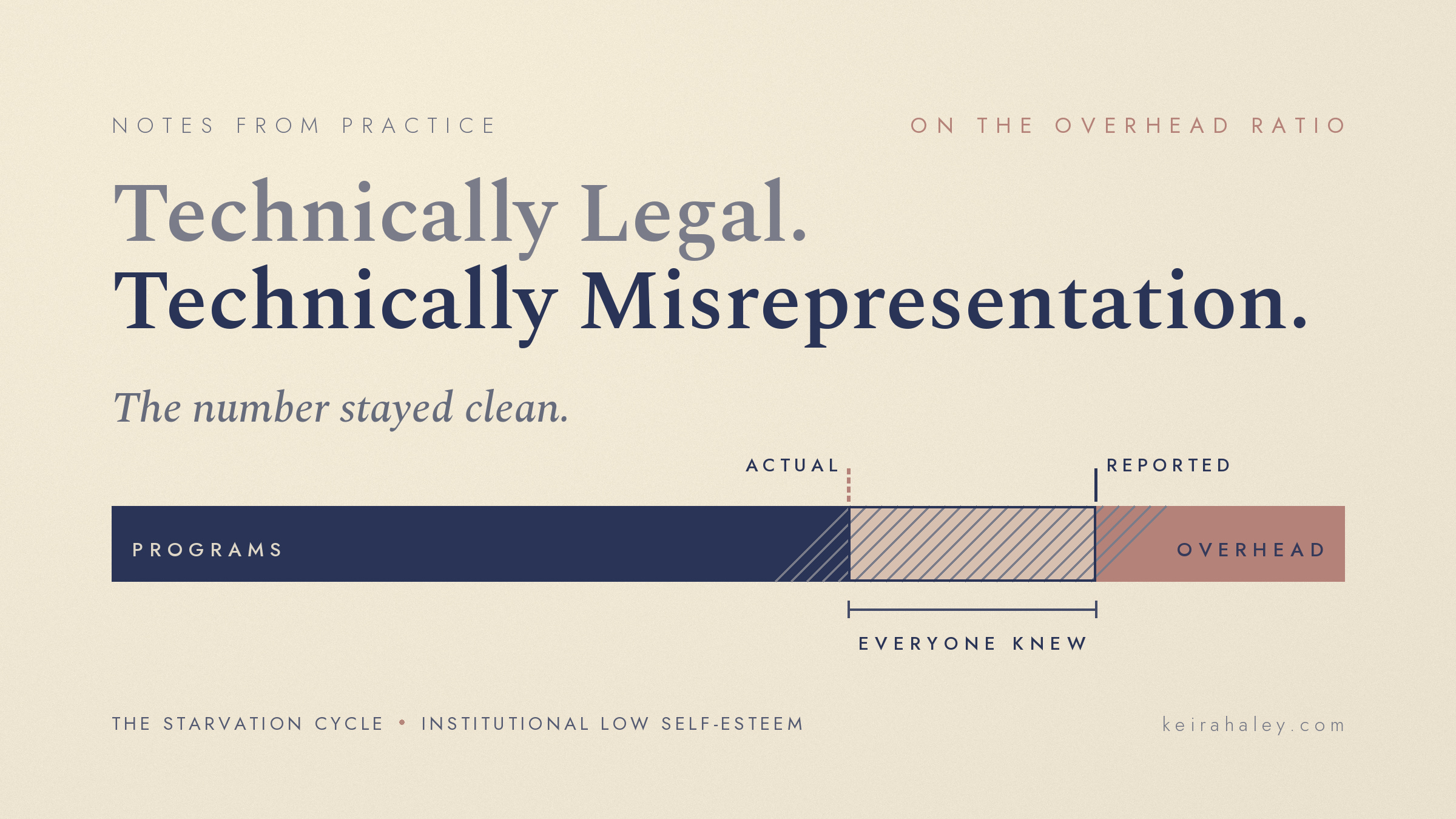
Technically Legal. Technically Misrepresentation.
Overhead Ratios, the Nonprofit Starvation Cycle, and Institutional Misrepresentation in Funding Systems

Someone decided that the measure of a good organization was how little it spent on itself.
The numbers needed to look right.
It was not a sector-wide decision. No table. No vote. The 1990s created the conditions. Efficiency as religion. Nonprofits held to business standards. Donors who suddenly wanted proof. A disposition that hardened into fact.
By the time anyone thought to challenge it, it had become common sense.
What percentage goes to programs. What percentage goes to everything else.
Their names became synonymous with accountability: Charity Navigator. The BBB Wise Giving Alliance. GuideStar.
They were not outside the sector. They were the sector. And the sector had decided what the sector was worth.
They were not all equally culpable. But the standard carried all three names.
One of them charged the organizations it rated for the privilege of displaying that rating. Fees ranging from one thousand to fifteen thousand dollars annually. Sixty-seven percent of its budget came from the charities it was evaluating.
They took complex nonprofit operations and reduced them to a number.
They were told it was the truth. Why wouldn’t they believe it? The standard was invented by the people publishing the scores. Certified by the people rating compliance.
And every nonprofit that starved itself to meet the standard made the standard look achievable. Which tightened it further. Which starved the next organization. Which made it look achievable again. The compliance cycle did the rest.
The sector handed the authority to itself. And then used it to finish the job.
We did this to ourselves. Not freely. Not without pressure. But we did it.
Call it what it is.
Institutional low self-esteem. When an organization internalizes the low value others have placed on it.
The skepticism would have cost us less.
The program director who needed management training didn’t get it. She managed within her ability. Two people quit. Recruiting their replacements cost more than the training would have.
The database hadn’t been updated since 2019. Staff worked around it. Hours every week, invisible, unlogged — because fixing the database was overhead and staff time wasn’t.
HR didn’t exist. Which meant the staff member being mistreated had nowhere to go. She stayed silent for two years. Then she left. Then she filed a complaint. The legal fees were not categorized as overhead. They were categorized as a crisis.
The executive director was charged with filling her own role and three or four others. She lasted three years past when she should have left. When she finally did, the organization spent eighteen months recovering. The deputy would have cost less. No one ran that number.
No one got raises. Not because the organization didn’t value them. Because the raise would show up in the wrong column.
The organization looked lean. It was held together by goodwill, exhaustion, and a copier that jammed every third page.
Program expenses that were really administrative. Salaries allocated to grants that didn’t cover them. Everyone knew.
Technically legal. Technically misrepresentation.
This did not hurt everyone equally.
Large institutions with endowments and wealthy board members could subsidize operations invisibly. A board member’s unrestricted check quietly covered the CFO’s salary. A capacity-building grant was really just overhead with a better name.
The number stayed clean.
Small organizations cut what they were told to cut. Kept the ratio where donors wanted it. And then wondered why they couldn’t retain staff. Why every strategic plan stalled at implementation.
They had been told they weren’t worth more. Long enough that it was internalized.
They were not failing because they lacked discipline. They were being underfunded by due diligence.
The relationships that unlocked flexible dollars were really the accumulated social capital of predominantly white, well-connected nonprofit leadership. It translated directly into organizational survival.
This was not only a donor problem.
A government contract told you what you could spend the money on. Running the organization wasn’t on the list. The overhead had to come from somewhere else. Usually it came from nowhere.
Donors get the blame. The government signed the contracts.
No one asks Amazon what percentage of revenue goes to programs.
The for-profit sector is celebrated for investing in itself. Research and development. Infrastructure. Talent. Innovation. These are not dirty words in a boardroom. They are strategy. They are how you build something that lasts. Wall Street rewards them. Business schools teach them.
We told nonprofits to run like businesses. We refused to fund them like one. That is a trap.
In the nonprofit sector, we name buildings after the gift that paid for them. Not the people who built the organization inside.
A technology company that loses money for a decade while it builds capacity is called visionary. A nonprofit that asks for a training budget is called inefficient. The difference is not the investment. It is not the risk. It is not the complexity of the work.
It is who benefits.
We decided that profit earns investment and welfare earns charity. Then we called it accountability.
Some problems got capital. Some got charity. We decided which was which. And then pretended we hadn’t.
Capital moves toward return. Builds what makes money. Leaves the rest. Whole communities. Whole populations.
Capital made the mess. The nonprofit cleaned it up, underfunded, on restricted grants, with staff held together by mission, exhaustion, and the random paperclips they found in the back hall closet. And then the corporation that made the mess wrote a check. Got the naming rights. Got the press release. Got the reputation as a good corporate citizen.
The gift was marketing. And the corporation got credit for caring about the mess it made.
It scales.
There is a child on a waitlist for mental health services. She is ten. The program that would have served her stopped — not because the need disappeared, not because the funding ran out, but because the organization couldn’t keep the staff to run it.
Her family kept calling.
Not them.
The Nonprofit Starvation Cycle was named by Ann Goggins Gregory and Don Howard in the Stanford Social Innovation Review, Fall 2009. The concept of institutional low self-esteem is the author’s own.
¹ The BBB Wise Giving Alliance charges charities fees ranging from $1,000 to $15,000 annually to license and display its charity seal — the public signal of its rating. This income provides 67% of the Alliance’s budget. U.S. Senator Richard Blumenthal publicly stated this financial relationship raises questions about “credibility and possible conflicts of interest.” The American Institute of Philanthropy, a competing charity rater, criticized the WGA for taking money from the same charities it was rating. Originally reported by USA Today. Source: BBB Wise Giving Alliance, Wikipedia; American Institute of Philanthropy.
² The relationship between funder expectations and nonprofit compliance is documented in the Urban Institute’s Nonprofit Overhead Cost Study (Wing, Hager, et al., 2004) and the Bridgespan Group’s consulting research cited in Gregory and Howard (2009).
Keira Haley | keirahaley.com
Trust the reader. Cut until it hurts. Earn the silence.