
That's Not a Hard Job. That's a Toxic One.
Toxic Workplaces, Workplace Gaslighting, and Invisible Labor in Mission-Driven Organizations

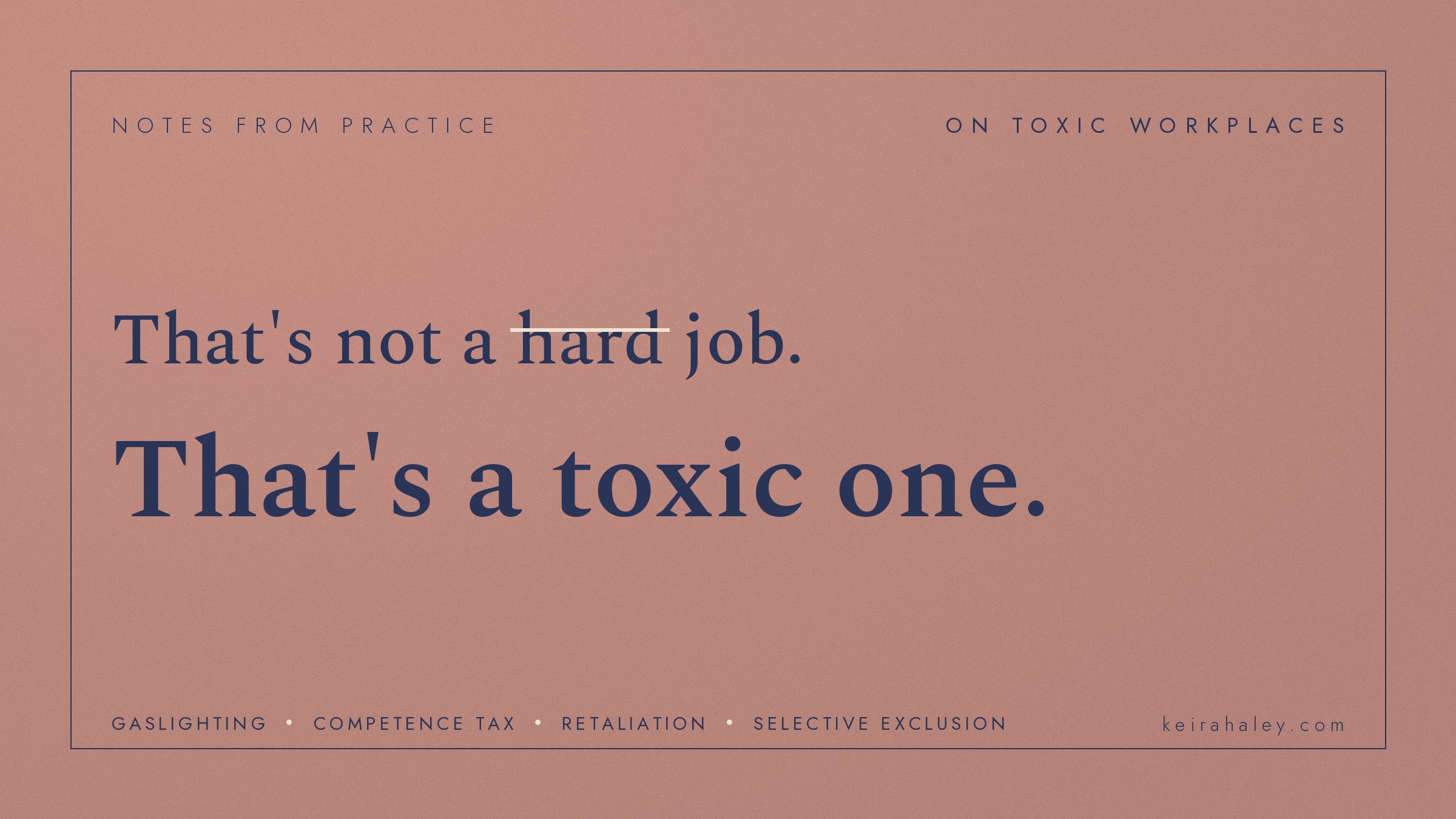
Hard jobs are supposed to be hard.
High stakes. Real accountability. Pressure that makes you sharper. A boss who tells you the truth even when it’s uncomfortable. Deadlines that matter because the work matters. That’s not what I’m talking about.
I’m talking about something else entirely. The workplace that doesn’t break you in one dramatic moment — it dismantles you slowly. The kind where you can’t quite name what’s wrong, but you’re rehearsing conversations in the shower. Checking your phone at 10pm just to manage your anxiety. Dreading Sunday nights. Watching yourself get smaller and calling it professionalism.
I’ve spent 20+ years inside mission-driven organizations. I’ve sat at senior leadership tables. I’ve been in the room when these decisions got made. And I’ve watched some of the most capable women I’ve ever known leave careers they were built for, not because they weren’t good enough, but because they couldn’t name what was happening to them fast enough to stop it.
So let’s name it. Because the first step to trusting yourself again is knowing you weren’t wrong about what you saw.
—
01 — Gaslighting
I want to start here because it’s the one that does the most invisible damage.
You raise a concern. You’re told you misread the room. You document something. You’re told it didn’t happen that way. You experience something clearly wrong, you felt it, you saw it, you have receipts and you’re told that’s not what happened.
And at first, you push back. But then it happens again. And again. And somewhere along the way, without realizing it, you stop trusting your own read of a room. You start apologizing before you’ve even said anything. You edit yourself down before every meeting. You wonder, genuinely wonder, if the problem is you.
That is the point. That is the damage.
I have watched women with twenty years of credibility and a track record that speaks for itself walk out of a conversation with their supervisor convinced they were the problem. Not because they were. Because they’d been told the story often enough that it started to feel true.
In a mission-driven organization, it sounds like this:
“I think you may have misread the room.”
“That’s not how that was intended.”
“I’m concerned you’re taking this personally.”
“We’ve never had anyone raise this before.”
“I wonder if you’re burned out — maybe you need a break.”
Here’s what makes it worse in nonprofits specifically: the mission becomes the shield. When you raise a concern, it gets redirected back to the cause — so questioning leadership starts to feel like questioning the work itself. You’re made to feel that your experience is noise.
It isn’t. Your experience is data. And you were right about what you saw.
—
02 — Competence Tax
This one is sneaky because it gets dressed up as a compliment.
You are doing your job. And you are also managing everyone else’s feelings about the job. The more capable you are, the more gets loaded onto you because you can handle it. Because you’re good with people. Because you always know what to say.
I remember being the person who got pulled aside before every difficult leadership meeting to “help keep things calm.” I was not the executive director. I was not paid to manage the executive director. But I was good at it, and I was trusted, and so it became mine. That’s how it works. Quietly. Without a conversation. Without a title change. Without additional compensation. One day it’s just yours.
You counsel the struggling direct report on your lunch break. You de-escalate the volatile leader before the board meeting. You smooth things over with the difficult funder your ED doesn’t want to deal with. You spend three hours on the phone with a colleague in crisis on a Tuesday night and show up Wednesday morning with your full slate of deliverables still due.
None of that labor shows up in your job description. None of it appears in your performance review. And none of it stops.
It reads as leadership. It is exploitation.
Competence is not consent. Being good at something does not obligate you to carry it indefinitely for free.
—
03 — Retaliation Disguised as Feedback
This is the one I want you to read slowly.
You do something inconvenient. You push back in a meeting. You decline a project that isn’t yours to carry. You name something that was happening, and nobody wanted named. You negotiate your salary. You support a colleague who raised a concern.
And then not immediately, but soon the feedback about your performance changes.
Suddenly, there are concerns about your leadership style. Questions about your culture fit that were never raised before. Vague observations that you’re “not a team player” or that you “struggle to see the big picture.” No specifics. No examples. No clear path to address it.
The feedback arrives right after the moment you stopped being convenient. That timing is not a coincidence. It is data.
Write it down; with dates. Every conversation. Every piece of feedback that appeared out of nowhere. Because if you ever need to defend yourself, or leave, or escalate that timeline is yours.
Believe the timing over the framing. Every time.
—
04 — Selective Exclusion
Your title says leadership. Your access says otherwise.
The real decisions happen before the meeting. In the informal lunch you weren’t invited to. The hallway conversation that continued after the call ended. The dinner with the board member that nobody mentioned until two weeks later. You find out what was decided in the all-staff. You learn about the reorg from a peer.
Your presence is used for optics. Your input is not used for decisions.
You cannot lead what you don’t have information about. Selective exclusion isn’t just disrespectful it actively undermines your ability to do your job and then holds you accountable for outcomes you had no way to see coming.
In nonprofits, this gets normalized as culture. Informal. Relationship-driven. The way things work here. It’s not culture. It’s a power structure. And it is designed consciously or not to keep certain people informed and certain people managed.
If you’re always the last to know, that’s not an accident.
—
The through line
In mission-driven organizations, every one of these behaviors gets wrapped in the language of the cause.
Your concerns become distractions from the mission. Your boundaries become proof that you don’t care enough. Your exhaustion becomes a performance issue. Your pushback becomes a culture problem. And through all of it, the implicit message is the same: if you really cared about the work, you wouldn’t be making this about yourself.
That message is a lie. And it is extraordinarily effective.
The most dangerous thing a toxic workplace does is make you think it’s normal. The most dangerous thing a mission-driven toxic workplace does is make you think your suffering is the price of doing meaningful work.
It isn’t.
The cause is not the culture. Don’t let anyone confuse the two.
If you recognized your workplace in more than two of these, that recognition is not paranoia. It’s clarity. Don’t talk yourself out of it.
Work shouldn’t cost you yourself.
— Keira Haley | keirahaley.com
—
Competence Tax: Additional invisible labor assigned to you precisely because you can handle it, without acknowledgment, compensation, or consent. Competence is not consent. The tax compounds over time and is never audited.
Competence Inversion: The reframing of expertise as ineffectiveness by the person least qualified to evaluate it. It is a self-protective mechanism that requires the demolition of the people most capable of exposing it. The institution does not reject her competence. It reclassifies it.
Selective Exclusion: The condition of holding a leadership title without leadership access. She holds the title. She is absent from the decisions. The institution needs both of those things to be true simultaneously: her visibility as proof of inclusion, her silence as proof of control.
These terms are part of the working lexicon. Read the full framework in Call It What It Is at keirahaley.com/lexicon
—
Trust the reader. Cut until it hurts. Earn the silence.