
The Model Is Broken
When Mission-Driven Work Is Funded to Perform, Not to Solve

We are doing serious work inside a system built to look like it’s solving problems.
Not to solve them.
—
We identified the problems society decided not to touch. Built organizations around them. Convinced high-net-worth individuals that we were worth their money. Reported back on their terms, in their language, by their deadlines.
And competed with every other organization, working on the same problem, chasing the same shrinking pool of funds while calling it a sector.
We did not build reserves. We did not plan for next year. We did not ask whether the structure itself was the problem.
We called this work. We called this mission. We called this the nonprofit sector.
And we are all, in some way, inside it.
The money is not structured to solve problems. It is structured to make them feel good.
Overhead caps punish investment in the organization itself. A philanthropic culture rewards the dramatic intervention over the fifteen-year commitment that actually closes the gap.
Not accidents. Choices. Made by people with the power to make different ones. We have accepted those terms so many times that they stopped feeling like a choice.
Then there is the proof requirement.
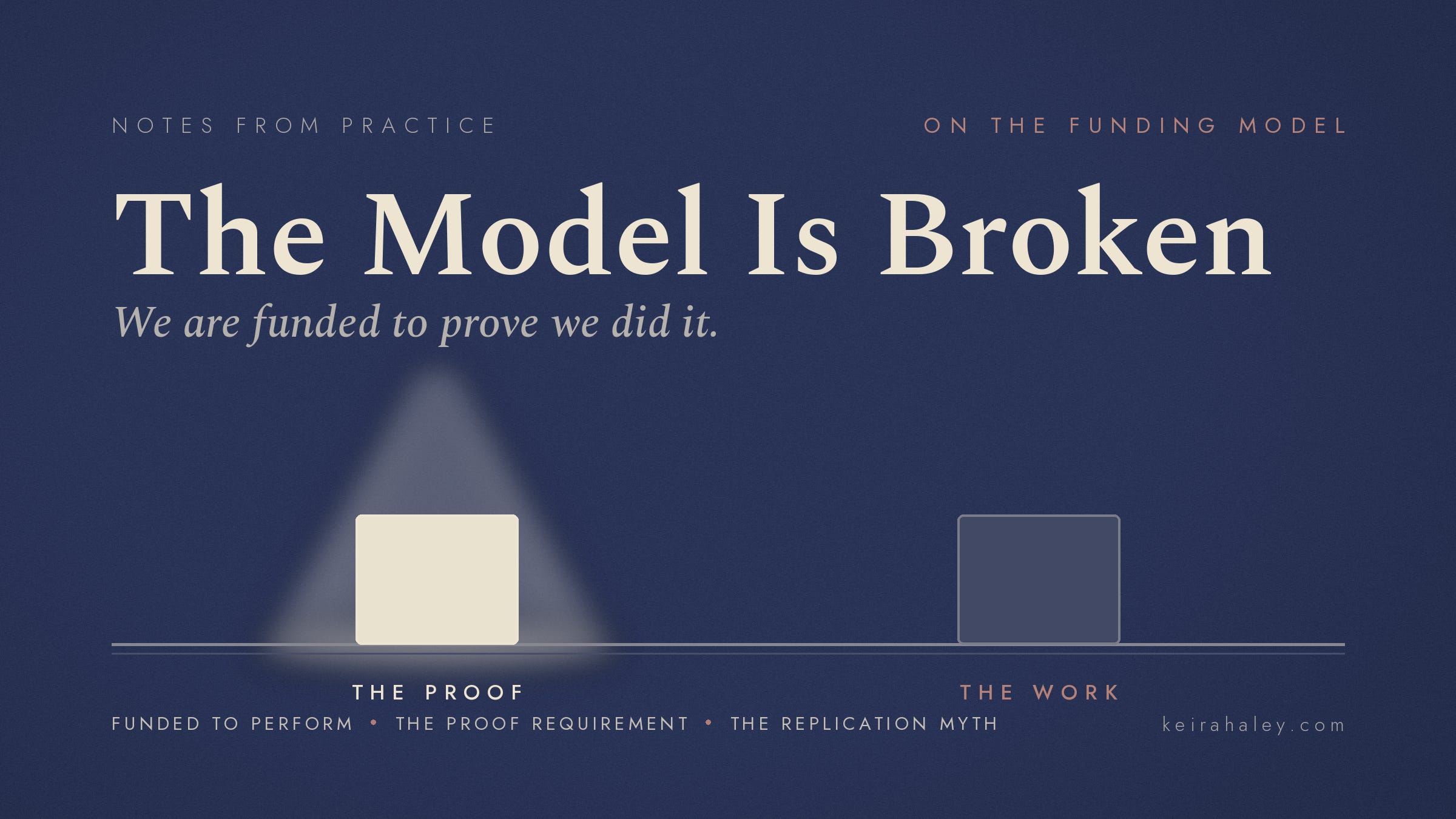
We are not funded to do the work. We are funded to prove we did it. Those are not the same thing. We spend enormous resources measuring, reporting, and demonstrating impact not to understand what is working, but to satisfy funders who will not release the next check without a deck that says it is. The measurement infrastructure costs money. It costs staff time. It costs the hours that could have gone to the problem itself.
We call this accountability. It is also a tax on the work, paid by the people who can least afford it. We write the reports. We present the decks. We have learned to perform rigor for an audience that will not be in the room when the work actually happens.
And then the replication myth.
A program works. A community changes. Funders get excited and want to scale it.
What they want, if we are honest, is a McDonald’s. A proven model. A training manual. Consistent outputs regardless of location. Open one here, open one there, same menu, same experience, same metrics. The formula travels. The results replicate.
I have sat across the table from a funder who used the word franchise without irony.
That is not how trust works. That is not how communities work. What made the program work was not the curriculum, the framework, or the logic model. It was the specific people who built it, in a specific place, over the years, until the community believed them. You cannot franchise that. You cannot put it in a replication grant and open a second location in a city that has a different history, different trauma, different everything.
The sector knows this. We write the grants anyway.
Wealth built through systems that produced the inequality gets redirected through philanthropy into legacy and influence. The same people who shaped the conditions now fund the response; on their timeline, by their metrics, with their names on the buildings.
We negotiate the terms of our own dependence and call it partnership.
The missions are necessary. The people are serious. The model that asks both to survive on goodwill and performance metrics is neither.
We know this. We have known it for a long time. We say it in hallways and parking lots and in the car on the way home. We do not say it in public, with our names on it, to the people who need to hear it.
The model will not change until the people inside it decide that saying so out loud costs less than staying quiet.
— Keira Haley | keirahaley.com
Trust the reader. Cut until it hurts. Earn the silence.