
The Translation, Part 3
Parts one and two looked outward.
This one doesn’t.
Because institutions do not only reshape the room. They reshape the people inside it.
This is what that feels like from the inside.
Constructed Complicity
The performance of loyalty in service of power rather than truth. Unlike Constructed Compliance, the belief is no longer fully internalized. The performance remains.
What we actually say:
You cannot trust her. She is not safe.
What she says publicly:
Full alignment. Visible loyalty. Consistent and convincing.
What she says when the door closes:
I know. Don’t tell anyone I said this. We all know what’s happening. I’m staying out of it.
What she is doing:
Preserving her judgment in private while adapting to power in public. Same building. Same day.
Why it persists:
The performance provides access. Safety. Belonging. The cost of truth is usually higher than the cost of participation. Most people inside it do not believe they are betraying anyone. They believe they are surviving.
What it costs her:
A growing distance between what she knows and what she is willing to say. And credibility with the people watching. They see it. They say nothing. But they know. And they remember.
What happens when the source of power is gone:
The private account becomes speakable. Sometimes all at once.
What that reveals:
Not hypocrisy. Recognition. She knew more than she was ever able to say.
What no one ever told her:
The performance may have protected your position. It also taught everyone watching which truths were safe to speak and which were not. That lesson travels further than you intended.
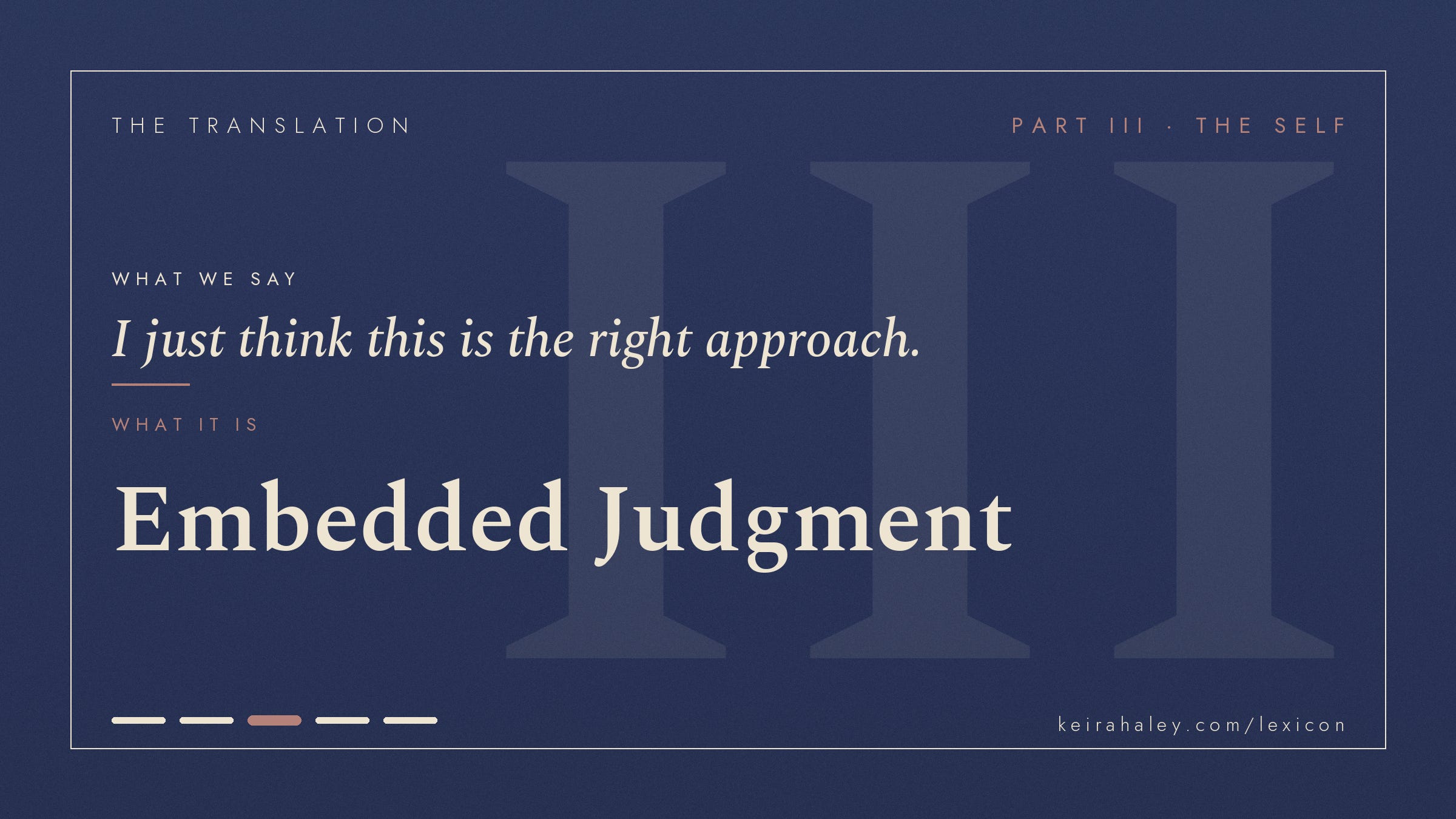
Embedded Judgment
Judgment shaped by the system that feels like your own and is no longer distinguishable from it. You are not making decisions. The institution is making them through you. The first sign of recovery is the discomfort of noticing.
What we actually say: I just think this is the right approach.
What we don’t say: I have been inside this system long enough that I can no longer locate where it ends and I begin.
What it sounds like: Conviction. Institutional fluency. Leadership.
What it is: The institution speaking in your voice. Borrowing your credibility. Moving through your relationships.
What it feels like from the inside: Nothing. That is the point. It feels like thinking.
The first sign it is happening: You find yourself defending decisions you would have questioned three years ago. Explaining away things that should trouble you. Making arguments that feel less convincing once the meeting is over.
The first sign of recovery: A sentence comes out of your mouth and lands wrong. Not to anyone else. To you.
What no one tells you: You did not lose your judgment. It was gradually replaced by a version that was more useful to the institution. Recovery begins when you can hear the difference.
Signal Return
The moment you recognize that what felt like your own thinking was shaped by the system, and your instincts become distinguishable again. Not confidence. Not healing. The desire to stop proving yourself within cultures that do not protect you.
What we actually say: I cannot keep doing this.
What we mean: I cannot keep contorting myself into a shape the institution requires and calling it growth.
What it feels like before it arrives: Exhaustion so familiar it no longer has a name. A self so managed it no longer feels like yours.
What it feels like when it arrives: Quieter than you expected. More certain than anything the institution ever offered you.
What shifted: The measure changed. What once felt important no longer did. What once felt impossible became obvious. The institution stopped being the audience. Something more real took its place.
What signal return is not: Confidence. Certainty. Healing. It is simpler. It is the moment your own signal becomes audible again.
What no one tells you: You did not find yourself. You remembered what you were listening for before the system taught you to listen for something else.
To Sit With Cockroaches
To survive the person who decides the room until you can leave them.
What the room looks like: She arrives at noon. She leaves at three. She cannot articulate a year-long strategy. She does not understand the concept of a challenge match for Giving Tuesday. She thinks those things don’t work.
What you did: You documented it. You drew the red line. You took it to HR with evidence.
What HR did: Did not show her. Did not address it. Protected her anyway.
What she did next: Put you on a PIP.
What the donors do when you leave: They call you. Not the institution. You.
What you do with that call: Forward it. Professionally. Without comment.
What you don’t say: Get your shit together.
What sitting with cockroaches requires: That you remain functional, professional, and present inside a dynamic designed to make you appear to be the problem. That you let the evidence accumulate without detonating it. That you survive her long enough to leave on your own terms.
What it costs: More than it should. Less than leaving before you were ready would have.
What no one tells you: Surviving her was not weakness. It was strategy. And the donors knew exactly who did the work.
What remains: You don’t forget what it felt like to sit in it.
Inherited Ambition
Ambition passed down with the beliefs required to sustain it, but not the cost those beliefs carry, and not the permission to name what that cost is. Each generation of women in the sector receives the aspiration without the accounting. The transmission is real. The omission is structural.
What they gave you: Investment. Belief. The foundations to succeed. A genuine desire to see you grow.
What they didn’t give you: What it costs to work inside dysfunction. What to do when the structure fails you. What to call it when it does.
Why they didn’t: Not because they were withholding. Because they were inside it too. They survived it. They called it growth. They passed on what they had language for.
What we actually say: She was such a wonderful mentor.
What we say ten years later: I wish someone had told me what I was walking into.
What the omission costs: You arrive believing the foundations are enough. They are not. You spend years trying to understand why the preparation that should have protected you didn’t.
What no one told either of you: The sector does not give women the language for its own dysfunction. That omission is not accidental. It is how the cycle continues. Each generation inherits the ambition and learns the cost alone.
What changes when you name it: The cycle stops being invisible. It becomes interruptible.
Vision Without Sight
The condition of being the only one in the room who can see inside a structure that cannot see you, and cannot see what you are offering. The institution does not reject the vision. It simply has no architecture for holding it.
What happened: You were asked to lead. You led. You built the strategy. You presented it. You were told you had spent too much time on it.
What you were told your focus should be: Something smaller. Something safer. Something the institution already knew how to hold.
What the institution could not say: We asked for vision and do not know what to do with it now that it is here.
What vision without sight looks like from the outside: She is not a team player. She is too much. She is not the right fit.
What it looks like from the inside: You can see exactly where this is going. You built the map. No one is looking at it.
What the institution does with the vision: Nothing. It does not reject it. It does not engage with it. It simply has no room for it and returns it to you as evidence of misplaced priorities.
What no one tells you: The problem was never the vision. The problem was the architecture. You were inside a structure that could not receive what it asked for. That is not a reflection of the work. It is a reflection of the room.
What you do with it anyway: You carry it out with you when you leave. And you look for the room that was built for it.
*This is an emerging framework for understanding institutional behavior, still in development.
Trust the reader. Cut until it hurts. Earn the silence.
© Keira Haley 2026. All terms original. keirahaley.com