
The Translation, Part 4

Parts one, two, and three looked at what happens to her.
This one looks at who built the room.
Not the colleague who undermined her. Not the manager who moved the finish line. Not the culture that made her doubt herself.
The architects. The ones with the resources, the titles, the board seats, and the signatures. The ones the institution was built to serve and built to protect.
She has been inside the room long enough now to see it clearly.
This is what she sees.
Performative Philanthropy
The practice by which institutional donors, boards, and civic elites direct resources toward mission-driven organizations not primarily in service of the mission, but in exchange for proximity to power, recognition within a social field, and the preservation of the identity of being a giver.
What the gala looks like from the outside: Generosity. Community. Investment in something that matters.
What the gala looks like from the inside: A room full of people purchasing proximity. To each other. To the mission. To the version of themselves that gives.
What the development officer knows and cannot say: The gift is not about the cause. It is about what the cause allows the donor to be.
What she says at the debrief: The event went beautifully.
What engaged means: They were seen. By the right people. In the right light.
What the mission received: Enough to justify the event. Not enough to change anything structural.
What she says to herself driving home: Six months of cultivation. Two months of programming.
What the donor believes: That they are part of something important.
What they are part of: A system that requires their belief in order to function. That is not the same as the mission. Adjacency is not impact.
What the institution requires to function: That the room keeps filling. That the belief holds. That no one in the gala asks whether the mission is being served or whether the mission is serving the room.
What no one ever said to her: You were not failing at fundraising. You were succeeding at a version of it that was never designed to change anything. That is not a reflection of your work. It is a reflection of who the room was built for.
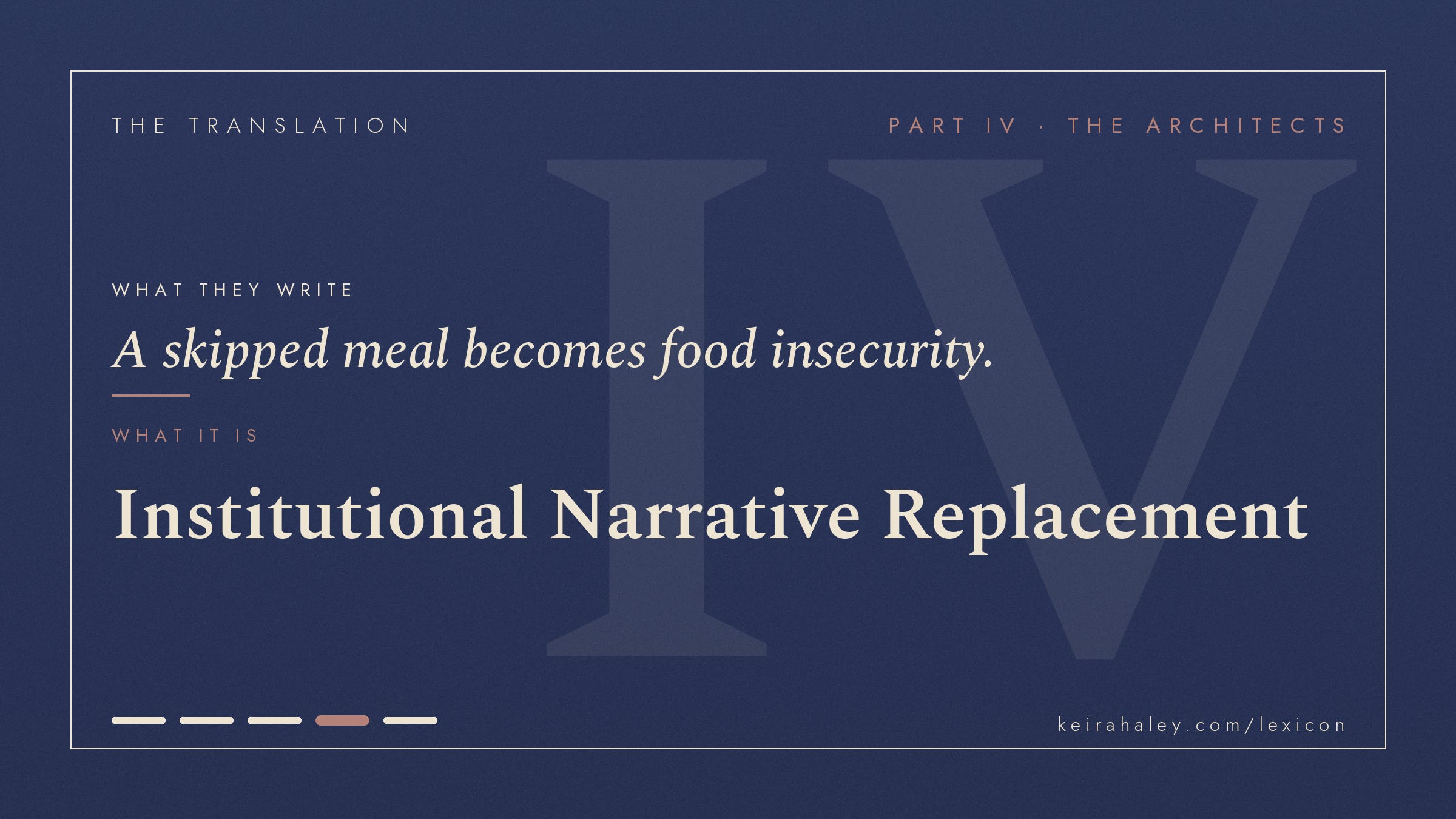
Institutional Narrative Replacement
The process by which lived experience is revised through institutional standards of legitimacy, risk, and circulation until the revised version displaces the original account as the institutionally usable form of knowledge. The original does not disappear through denial. It disappears through replacement inside the institutional record.
What she is asked to do: Review the copy. Make it campaign-viable.
What campaign-viable means: Remove the detail least compatible with institutional language. Make it something that can move cleanly through donor-facing systems.
What the revision looks like: A missed rent payment becomes housing instability. A skipped meal becomes food insecurity. A student sleeping in a car between shifts and class becomes unstable living conditions during enrollment.
What follows each revision: Nothing. The absence signals alignment.
What she learns to do before anyone asks: Remove the friction herself.
What she says when a quote is flagged as too specific: Nothing. She moves it. From headline to support. From support to appendix. Then it disappears from the final narrative entirely.
What the institution calls this: Editing.
What she calls it three years later: The moment I stopped trusting myself. Not all at once. Revision by revision.
What the cursor stays on: “Jake cannot afford to be here, but he shows up every day.”
What anecdotal means in this context: Not a judgment of truth. A judgment about what can function as evidence. The quote moves into student voice. It no longer functions as evidence. Only supporting material.
What no one ever said to her: Your instincts were right the entire time. What you were asked to do was not editing. It was replacement. And it cost you something real. Not your empathy. Your certainty that your empathy was still yours.
Reflected Appointment
When the hire exists to confirm the legitimacy of the decision that produced it. The placement is not about the candidate. It is about what the decision allows the institution to believe about itself. The credential is borrowed. The accountability is not. The decision is made by the people furthest from the work. They will never sit inside the culture they just sanctioned.
What they saw: The performance of competence. The language without knowing what it looks like when it is actually done.
What they chose: Well. By their own measure.
What the people inside the vertical inherit: Her. And the consequences of a decision made by people who will never live them.
What no one says out loud: The search firm bore no accountability. The CEO bore no accountability. The people inside the vertical bore all of it.
What no one ever said to the people left inside it: The decision was never about competence. It was about confirmation. And confirmation requires no proximity to the work. Only proximity to the person who made the call.
Structured Fog
The condition in which an institution’s dysfunction occupies the gap between experience and language, making harm visible enough to be felt and invisible enough to be denied. The gap is real. The institution maintains it.
What she says to the friend across the table: Something is wrong. I cannot explain it. Every time I try it sounds like nothing.
What sounds like nothing means: The institution has occupied the gap between what she can feel and what she can prove. That gap is not accidental. It is maintained through design.
What the institution says when she raises it: We take all concerns seriously. We have processes for this.
What processes means: Documentation requirements designed to make informal harm formally unprovable.
What she does with the processes: She follows them. She documents. She submits.
What happens to the documentation: It enters a system designed to produce outcomes the institution can defend.
What she is left with: The experience. No institutional record of it. A growing sense that she is the problem for continuing to name it.
What the fog requires of her: That she either accept the institutional account or appear unreasonable for rejecting it. Both outcomes serve the institution.
What no one ever said to her: The fog is not your confusion. It is their architecture. You were trying to describe something the institution spent considerable effort making impossible to describe. That effort was not an accident. It was a decision. And decisions have architects.
This is what she sees now.
Not because she became cynical.
Because she stayed long enough and looked carefully enough and refused, in the end, to call it something other than what it was.
The room was built before she arrived.
She is not the first to have sat in it.
She will not be the last.
But she is one of the ones who left with language.
And language, unlike the institutional record, cannot be revised without her consent.
These terms are part of the working lexicon at Call It What It Is. The framework, all 29 terms, lives at keirahaley.com/lexicon.
© Keira Haley 2026. All terms original.
Trust the reader. Cut until it hurts. Earn the silence.