
Why We Do It
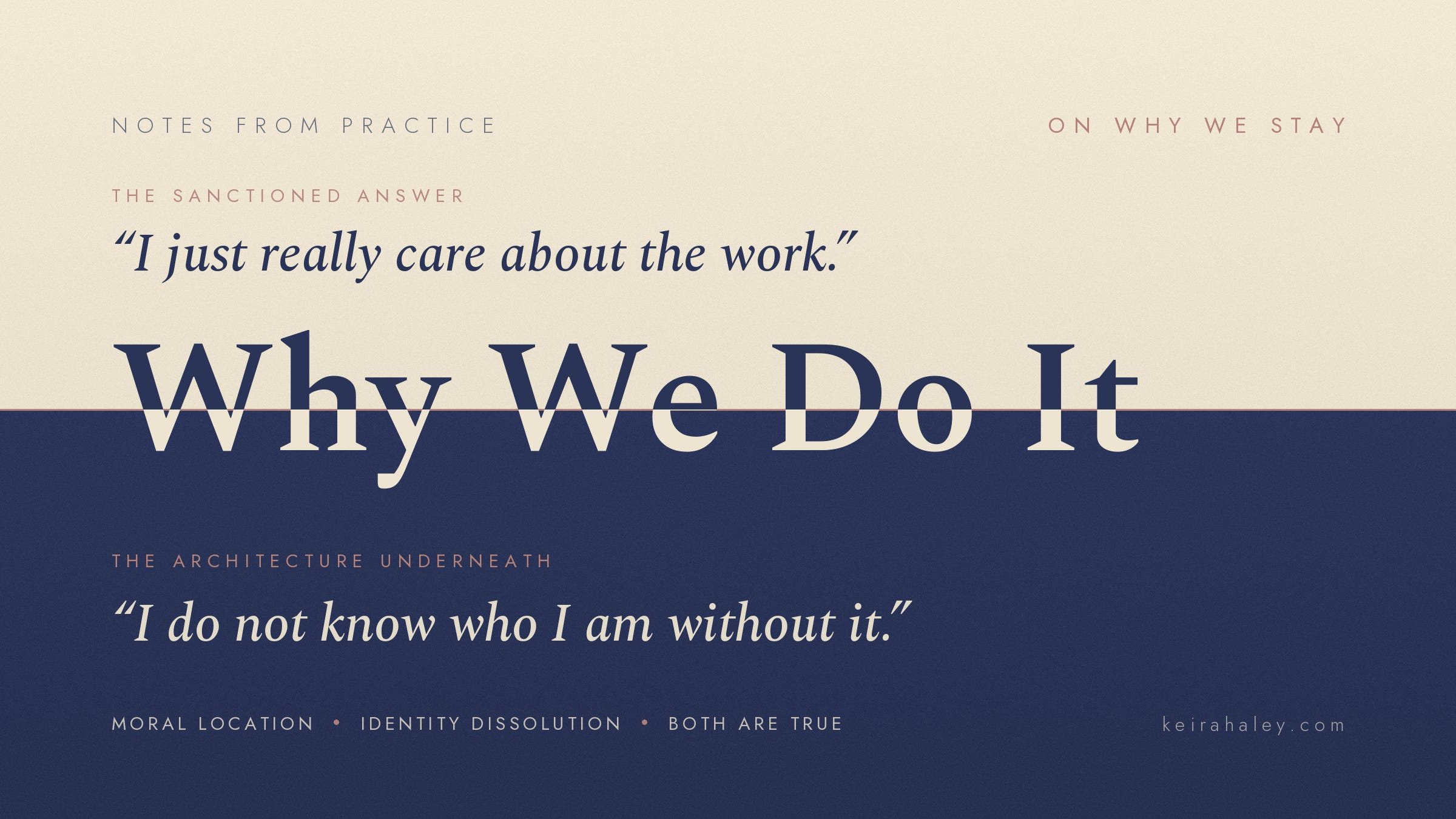
I do not know who I am without it.

There is a specific way people in this sector answer the question “what do you do.”
Something lifts. The answer lands differently than other answers. It carries weight in a way that “I work in finance” or “I’m in sales” simply does not. You feel it when you say it. You have always felt it.
That lift is worth examining.
—
We have a clean answer to why we are here.
We believe in the mission. We chose meaning over money. We are here because the need is real and someone has to show up. Research confirms it — nonprofit workers consistently show stronger intrinsic and altruistic motivation than their for-profit counterparts. We are, by measurable standards, more mission-driven than most.
That is the sanctioned answer.
Now the architecture underneath it.
—
A 2020 study in Frontiers in Psychology found something the sector prefers not to examine: in nonprofit organizations, altruistic and egoistic motivations do not cancel each other out. They coexist. Both shape organizational identity. Both explain why people stay. The researchers were direct — joining this sector involves righteousness and self-interest simultaneously.
Psychologists studying prosocial behavior have found the same from a different angle. People are not only motivated to do good. They are motivated to be good. To hold a positive identity. To have a self they can point to.
Those two things are nearly impossible to separate.
The sector has decided not to try.
—
This work gives us a self. Not just a job — a self.
An identity that does something in bios, in conversations, in the quiet accounting we run about what kind of person we are. The way “I work in nonprofits” is never just information. It is moral location.
We just don’t say that out loud. We say we’re here for the mission.
Both things are true. The sector only has room for one of them.
—
When we cannot name our real motivations, we cannot examine them.
We cannot ask whether we are staying because the work needs us or because we need the work. We cannot notice when the identity has become more important than the impact — when we are protecting the role, the title, the sense of self, more than the mission we claim to serve.
Think about what happens when it ends. When the org closes, the grant dries up, the role disappears. For some people that is a job loss. For others it is closer to an identity dissolution. Because the work was not something they did. It was how they knew who they were.
The sector calls that an exit.
It does not ask what left with the person.
—
The belief is real. The care is real. The impact is real.
That is not the argument.
We have confused caring about the work with examining it.
They are not the same thing.
We say: I just really care about the work.
We do not say: I do not know who I am without it.
The question is not why the work matters.
The question is why we need it to.
We have not asked it yet.
—
Sources
Li, Y. & Zhang, Y. (2020). From Motivation to Organizational Identity of Members in Non-profit Organizations: The Role of Collectivism. Frontiers in Psychology, 11:1881. doi:10.3389/fpsyg.2020.01881
Schepers, C., De Gieter, S., Pepermans, R., Du Bois, C., Caers, R., & Jegers, M. (2005). How are employees of the nonprofit sector motivated? Nonprofit Management and Leadership, 16(2), 191–208.
Bryan, C.J., Walton, G.M., Rogers, T., & Dweck, C.S. (2011). Motivating voter turnout by invoking the self. Proceedings of the National Academy of Sciences, 108, 12653–12656.
— Keira Haley | keirahaley.com
Trust the reader. Cut until it hurts. Earn the silence.